The Cold Calculus of a Champion: Gilbert Arenas’s Ruthless Trade Demand for Austin Reaves Exposes the Lakers’ Existential Crossroads Between Loyalty and Legacy, Forcing a $241 Million Decision That Will Define the Post-LeBron Era
The declaration was not made in a front office war room, but on a podcast, wrapped in the casual, unfiltered bravado of a former All Star who understands the league’s brutal mechanics. Gilbert Arenas, whose own career was a fireworks display of audacious shot making and dramatic turns, looked at the Los Angeles Lakers’ most cherished asset homegrown star Austin Reaves, in the midst of a career shattering breakout season and issued a command that felt like a betrayal of the heart but an alignment with the cold brain of championship pursuit: “Get rid of him now while his stock is so high.” The statement hangs in the air, a stark business proposition against the emotional backdrop of Lakerland.
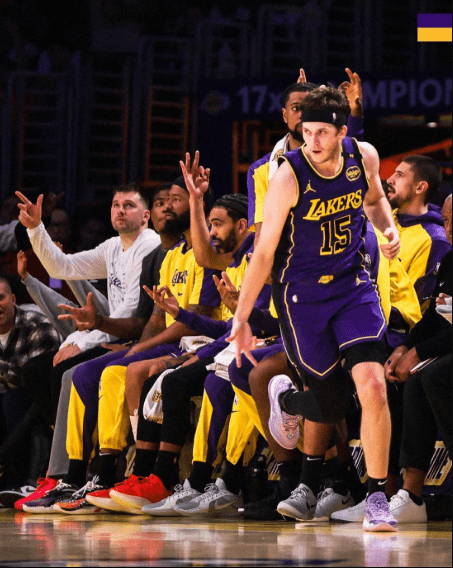
Reaves, the undrafted overachiever from Arkansas, has become the franchise’s most reliable source of joy and hope in the turbulent post championship years. He is the gritty, skilled personification of “Laker for Life” dreams. Yet, Arenas, channeling the ghost of Jerry West’s ruthless genius, points to the ticking clock and the shimmering names on the 2027 free agent horizon Jokic, Giannis, Mitchell and suggests that true love in the NBA is measured in banners, not contract extensions. This is not a debate about Reaves’s talent. It is a dissection of the Lakers’ soul. Are they a franchise that rewards the fighter who climbed the mountain with them, or are they the superteam architects who view every player, no matter how beloved, as a potential trade chip in the relentless, cynical pursuit of the next transcendent talent? Arenas has not proposed a trade; he has lit a fuse on the central dilemma of modern sports, forcing the Lakers to choose between the narrative of loyalty and the hard reality of legacy.
The numbers paint the portrait of Reaves’s undeniable, and perfectly timed, ascent. 27.8 points, 5.6 rebounds, 6.7 assists per game. He is no longer the clever supplementary piece; he is the clear, dynamic No. 2 option behind Luka Dončić, carrying an unprecedented offensive load with efficiency and clutch poise. This explosion coincides precisely with his contractual pivot point: the decision to decline a $89 million extension and his upcoming $14.9 million player option, setting the stage for a potential $241 million maximum contract next summer. His value will never be higher, and his cost to the Lakers will never be more daunting. Into this high stakes moment steps the shadow of General Manager Rob Pelinka’s long telegraphed master plan: the 2027 cap space gambit.
By meticulously managing the books, Pelinka aims to have a clean financial slate to pursue the true unicorns of the sport the Jokics and Giannises of the world. In this coldly logical framework, Austin Reaves’s magnificent breakout presents not just a reward dilemma, but a strategic crisis. Paying him a supermax contract in 2026 could immediately clog the financial arteries needed for the 2027 supernova splash. Arenas, with the clarity of an outsider, sees the dissonance. He frames it with brutal simplicity: if Reaves is your permanent No. 2, you pay him. But if he is merely a placeholder for a coming god, then he is an asset to be liquidated at peak value. This is the “sell high, win big” mantra applied to a human being’s career. It reduces the emotional bond between a city and its player to a stock ticker. And in the unfeeling algebra of championship odds, Gilbert Arenas might just be the only one doing the math correctly.

1. The Arena of Value: Understanding Reaves’s Unprecedented Stock Peak
Austin Reaves’s current season is not just an improvement; it is a systemic reinvention of his basketball identity and, consequently, his market valuation. Every metric screams peak trade asset.
The scoring leap to near 28 points per game is the headline, but the method is what intrigues contenders. He is no longer just a connective playmaker and spot up shooter. He is a primary initiator, running high pick and rolls, attacking mismatches, and creating his own shot at all three levels.
His efficiency has scaled with his usage, a rare and precious combination. He is drawing fouls at an elite rate, hitting threes off the dribble, and making advanced reads out of double teams. He is proving his game can be the engine of an offense, not just a complementary piece.
Defensively, while not a stopper, he has graduated from a target to a competent, high effort team defender who understands positioning. He is no longer a liability you hide; he is a neutral piece you can scheme with.
Crucially, his contract is the ultimate sweetener. For this season and next, he represents elite production on a mid level value deal. For a team dreaming of contention, adding a 27 point scorer without gutting their cap sheet is a fantasy scenario.
This creates a perfect storm of tradability. Contenders see an immediate, cost controlled star who can elevate their ceiling. Rebuilding teams see a young, marketable franchise face to build around. His value is universal.

Arenas’s point is rooted in this ephemeral moment. This peak is built on unprecedented opportunity and unsustainable, career high shooting splits. The moment the Lakers commit $50+ million annually to him long term, his trade value plummets. He becomes a financial commitment, not a flexible asset.
Right now, Reaves is the most attractive combination of proven production and future potential on a team friendly deal in the entire league. In the NBA’s asset management paradigm, there is no better time to sell.
2. The 2027 Phantom: Rob Pelinka’s High Stakes, Long Game Gambit
Gilbert Arenas’s directive cannot be understood without the looming specter of 2027. This is not a random year; it is the calculated endgame of Rob Pelinka’s multi-year roster strategy, a date circled in blood red ink in the Lakers’ front office.
The plan was signaled with the non commitment to Dorian Finney Smith and other mid tier veterans. The message was clear: preserve maximum flexibility for the 2027 free agent class, a potential galaxy of superstars headlined by Nikola Jokic, Giannis Antetokounmpo, and Donovan Mitchell.
Pelinka’s philosophy is the antithesis of incremental team building. It is the “Superstar or Bust” model that has defined the Lakers for decades. It requires a clean cap sheet, a major market’s allure, and the willingness to let good players walk to chase the chance at a great one.
Austin Reaves’s explosion directly threatens this monastic financial discipline. To keep him, the Lakers would likely need to offer a contract starting near $43 million annually in 2026-27. That single commitment would immediately consume the cap space needed to offer a true max contract to a Jokic or Giannis in 2027.
Therefore, in Pelinka’s calculus, Reaves presents a binary choice: he is either the long term cornerstone alongside Dončić, or he is the premier trade asset to either acquire a star sooner or accumulate the draft capital and young players to facilitate a 2027 sign and trade.
There is no middle path. Paying Reaves market value means abandoning the 2027 superstar dream. Chasing the 2027 dream means Reaves cannot be on the books at a supermax number. Arenas is merely stating the obvious conclusion: if the Lakers are serious about 2027, the time to convert Reaves into future assets is now, not later.
The gamble is immense. It bets that a bird in the hand (a proven, ascending All-Star in Reaves) is worth less than two in a bush (the chance to pitch a 32 year old Jokic or Giannis in two years). It is a risk that defines franchises for a decade.
3. The Giannis Gambit: Robert Horry and the Generational Talent Trap
The theoretical endpoint of Arenas’s “sell high” argument found voice in Lakers legend Robert Horry. “Big Shot Rob” explicitly named the target: Giannis Antetokounmpo. He urged the Lakers to offer Reaves as the centerpiece for the Greek Freak should he become available.
This proposal illuminates the brutal hierarchy of NBA talent. As Horry stated, comparing Reaves to Antetokounmpo is “not even fair.” Giannis is a generational, two-time MVP, Finals winning force of nature. Reaves is an ascending All Star.
However, in the economics of superstar trades, the outgoing team never receives equal basketball value. They receive the best package of assets available: young players, draft picks, and financial relief. Reaves, at his peak value, could be the most attractive single basketball player offered in any Giannis sweepstakes.
The Bucks, in a hypothetical rebuild scenario, would look at a 27-year-old Reaves putting up star numbers and see a foundational piece to market to their fanbase a proven, charismatic scorer to build around.
For the Lakers, it’s the ultimate consolidation move. You trade a player of great value for a player of historic value. You exchange a very good present for a potentially dominant one. The risk is gutting the supporting cast, but the reward is a Dončić Antetokounmpo duo that would instantly be the most terrifying in basketball.

Horry’s and Arenas’s points converge here. If such a universe exists even as a remote possibility you must have Reaves’s contract on your books as a tradeable asset, not as an unmovable supermax contract. His current deal is a key; a future supermax is a lock. Champions like Horry think in keys.
4. The Intangible Tax: The Cost of Betraying “Laker for Life”
The Arenas Doctrine ignores a crucial line item on the Lakers’ balance sheet: the Intangible Tax of Loyalty. The Lakers are not just a basketball team; they are a cultural institution with a mythology built on relationships Magic and Kareem, Kobe and Shaq, Kobe and Pau.
Austin Reaves represents the modern incarnation of the “Laker Made” ideal. The undrafted kid who grinded his way into the rotation, shined in the playoffs, and earned the city’s unwavering love. Trading him at the moment of his apex for purely financial reasons is a profound betrayal of that narrative.
This tax is paid in the locker room and in future free agent meetings. What message does it send to other players? That hard work, improvement, and loyalty are ultimately just leverage for your own trade value? That no matter how much you bleed purple and gold, you are a line item?
For a franchise that sells itself on legacy and family, this is dangerous territory. It could undermine the very culture they need to attract those 2027 free agents. Would Jokic, a loyalist himself, want to join a franchise known for discarding its homegrown stars at their peak?
Furthermore, Reaves’s chemistry with Luka Dončić is palpable. They have developed a seamless two man game. Dismantling that synergy for a theoretical future gain is a massive basketball risk. The next star might not fit as well. The traded picks might not convey. The 2027 plan might fail.

The Lakers must calculate whether the potential basketball upgrade is worth the certain cultural damage and the very real risk of disrupting the on court harmony they are finally building. Sometimes, the best business decision is to pay the loyalty tax.
5. The Precedent of History: When the Lakers Chose Business Over Beloved
History offers a chilling precedent for this exact crossroads. The year was 1996. The beloved Laker was Nick Van Exel, the fiery, talented point guard who was the heart and soul of the young, exciting Lakers teams of the mid-90s.
After a deep playoff run and an All Star season, Van Exel was due a major payday. The Lakers, however, had their eyes on a different prize: clearing max cap space for the 1996 free agency class, which included a certain giant from Orlando.
In a move that devastated the fanbase and shocked the league, the Lakers traded the popular Van Exel to the Denver Nuggets. The return was minor. The purpose was purely financial: to open the cap room necessary to sign Shaquille O’Neal.
The move was brutally successful. It directly led to a three peat dynasty. It also cemented a reputation for cold-blooded efficiency. Jerry West understood that sentimentality has no place in the pursuit of greatness.
Rob Pelinka, a protégé of that era, now faces his own Nick Van Exel decision. Is Austin Reaves the homegrown star you build with, or is he the financial obstacle you move to chase a Shaquille-sized whale in 2027? The ghost of 1996 looms over every discussion in El Segundo.

The difference is the scale of the gamble. In 1996, Shaq was a known, available entity. In 2025, Jokic and Giannis are theoretical targets two years away, with no guarantee they’ll want to leave or choose L.A. Trading Reaves is a leap of faith into a future that may not materialize.
6. The Verdict: Why Arenas’s Logic is Flawless, But the Decision is Not
Gilbert Arenas’s argument is logically flawless within the vacuum of asset management. He identifies peak value, identifies a looming financial conflict with a stated organizational goal, and advocates for proactive capital realization. It is Finance 101 applied to the hardwood.
However, the Lakers do not operate in a vacuum. They operate in the real world of chemistry, culture, fan sentiment, and immense uncertainty. The decision on Austin Reaves is not a spreadsheet function; it is a defining act of franchise identity.
The prudent path, the one that balances Arenas’s cold logic with the warm realities of team building, may be a middle ground. The Lakers could explore the trade market with ferocious diligence, listening to offers for Reaves to truly gauge his league wide value.
If a Godfather offer for a Top 15 player materializes, you make the trade. If the best offers are merely bundles of picks and prospects, you hang up and commit to Reaves as your long-term No. 2, adjusting the 2027 dream accordingly.
Ultimately, the Lakers must answer the core question Gilbert Arenas posed: Is Austin Reaves your guaranteed No. 2? If the answer, after this spectacular season, is still “no,” then Arenas is right you trade him now, embrace the full rebuild around Dončić and 2027 plan, and accept the consequences.

But if the answer is “yes,” you silence the noise, you pay the man his $241 million, you build your franchise around the Dončić Reaves backbone, and you chase championships with the devil you know, not the gods you hope will descend from the free agent heavens in two years.
Arenas provided the brutal question. The Lakers’ answer will reveal not just their plan for Austin Reaves, but the very soul of the franchise in the 21st century.