The Unforgivable Confession: How Ayesha Curry’s Honest Admission About Not Wanting Marriage or Kids Ignited a Viral Inferno Exposing the Impossible, Hypocritical Rules of Celebrity Womanhood
The confession was not about scandal, infidelity, or regret. It was about a path not taken. On the Call Her Daddy podcast, in a moment of reflective honesty, Ayesha Curry wife of NBA icon Stephen Curry, mother of four, and a formidable entrepreneur in her own right dared to articulate a thought that lives in the silent recesses of millions of women’s minds. She admitted that the life she now cherishes was not the life she originally envisioned. “I didn’t want kids. I didn’t want to get married,” she said, describing her younger self as a would-be “career girl.” She spoke of naivete at 22, of a pregnancy that “was not on my bingo card,” and of a resilience forged in the beautiful, demanding chaos of young motherhood. It was a nuanced story of surrender, adaptation, and ultimate gratitude. The internet heard only the first part. Within hours, a curated clip detached from its hopeful conclusion became a digital firestorm. The backlash was swift, vicious, and illuminating.
Comments accused her of “embarrassing your man” and shouted, “Shout out to Steph for giving you the life you could never achieve on your own.” The response was not a critique of her opinion; it was a punishment for her honesty. In that moment, Ayesha Curry became a test case for the unwritten, unbreakable laws governing the famous wife. She violated the prime directive: thou shalt perform perfect, preordained gratitude. By admitting her life plan was different, she was seen as devaluing the prize she had won the life with Steph. The fury revealed a terrifying cultural truth: for a woman in the public eye, especially one married to a legend, her narrative is not her own. It is a supporting role in his epic.
Her journey must be one of destined, unwavering desire for the domestic crown she now wears. Any suggestion of a different dream is treated as treason against the fairy tale the public has purchased. Ayesha Curry did not complain about her life; she celebrated its unexpected shape. But in acknowledging the “before,” she committed the cardinal sin of suggesting there was ever an “after” that didn’t include him. And for that, a segment of the world decided she needed to be reminded of her place.

This episode is far more significant than another celebrity “cancel” attempt. It is a direct collision between authentic, complex female experience and the rigid, monolithic archetype society reserves for women who marry famous men. Ayesha Curry is expected to be the perpetual “good wife”grateful, uncomplicated, and defined solely by her relationship to her husband’s greatness. Her own success as a cookbook author, restaurateur, and lifestyle brand founder is often framed as a pleasant hobby enabled by his wealth, not as the achievement of the “career girl” she once aspired to be. Her confession pulled back the curtain on this script. It revealed a person with independent ambition, with a self that existed before and apart from the Curry dynasty. This is what the backlash seeks to correct.
The angry comments are a frantic effort to re-center Steph as the sun in her solar system. By claiming he “gave her the life she could never achieve,” they actively erase her labor, her talent, and her individuality, reducing her to a beneficiary of his grace. This protects the comfortable narrative. It’s easier to digest a perfect love story than a real one involving doubt, change, and personal evolution. Ayesha’s real crime was demonstrating that a woman can be profoundly happy with a life she didn’t plan, while still being honest about the planner she used to be. The internet, in its reductive rage, could not hold those two truths at once. So, it attacked the messenger for delivering a message more layered than its headlines could ever contain.
The Archetype vs. The Human: The Unwritten Rules of the “NBA Wife”
To understand the violence of the backlash, one must first understand the suffocating archetype Ayesha Curry is supposed to inhabit. The “NBA Wife” or “Athlete’s Spouse” is a role with a strict, if unwritten, code of conduct.
Her primary function is supportive adornment. She is expected to be a glamorous, unwavering presence in the stands, a serene foundation at home, and a silent partner in philanthropy. Her public narrative is one of destined gratitude.
She must perform the story of having been “won” by the athlete. Her life before him is rendered irrelevant, a prelude to her true purpose. Any expression of a previous, independent identity is seen as a threat to this narrative.
Her own ambitions are permissible only as non-competitive extensions of her husband’s brand. Launching a charity? Noble. Starting a cooking show? Charming. Building a restaurant empire? Acceptable, as long as it feels like a “passion project” rather than a rival corporate entity to her husband’s sports dominance.
Most crucially, she must never, ever publicly complicate the fairy tale. She cannot express doubt, fatigue, or as Ayesha did an alternate vision for her own existence. To do so is to commit narrative heresy.
Ayesha’s interview breached every one of these rules. She spoke of a self that existed independently (“career girl”). She framed her marriage and motherhood not as a pre-written destiny, but as a beautiful detour. She presented herself as an individual who evolved, rather than a trophy who was collected.
The backlash was the archetype’s immune system kicking in, trying to reject this foreign body of complexity. The comments insisting she “speak to a mental health professional” are a modern way of saying, “Get back in line. Your happiness must look like our fantasy.”

The Anatomy of a Viral Misquote: How Nuance Gets Murdered in the Click Economy
Ayesha Curry’s full message was one of retrospective surprise and current contentment. The internet’s version was one of present regret and ingratitude. This chasm is not an accident; it is the engineered product of the modern content machine.
The process follows a lethal formula. First, a two-hour podcast interview is mined for its most explosive 15-second soundbite. The clip is surgically removed from the surrounding context of laughter, tone, and concluding reflections.
This clip is then packaged with a maximally provocative caption: “AYESHA CURRY DROPS BOMBSHELL: ‘I Never Wanted to Marry Steph or Have Kids!’” The truth that she is describing her mindset as a teenager and young adult is buried.
This manufactured “controversy” is then fed into the engagement algorithms, which are blind to truth but acutely sensitive to reaction. Outrage, defensiveness, and tribal argument are the premium fuels. Nuance is a coolant that slows the engine.
The result is a public trial based on a false premise. People are not reacting to what Ayesha Curry said; they are reacting to a caricature of what she said. They defend a “perfect” Steph Curry from an attack he never suffered, and chastise a “ungrateful” Ayesha who doesn’t exist.
By the time the full context circulates, the narrative has set like concrete. The correction never achieves the velocity of the lie. Ayesha and Steph are then placed in a no-win public relations trap: address the false narrative and give it more oxygen, or stay silent and let it solidify.

Their choice to “let their love speak for itself” is a dignified refusal to play a game rigged against authenticity. It is an understanding that in the court of viral opinion, a full transcript is never entered into evidence.
The “Shout Out to Steph” Fallacy: The Erasure of Female Labor
The most telling comment, and one repeated in various forms, was: “Shout out to Steph for giving you the life you could never achieve on your own.”
This single sentence distills the entire oppressive worldview fueling the backlash. It operates on three poisonous assumptions.
First, it defines “a life” solely in material terms. It assumes the pinnacle of Ayesha’s ambition was the wealth and status afforded by Steph’s NBA career, erasing her stated desire for a career of her own making.
Second, it actively erases her labor. Ayesha Curry did not wake up one day as the owner of a lifestyle brand and multiple restaurants. She built them. She writes cookbooks, hosts shows, and manages a brand. The phrase “on your own” dismisses this work as inconsequential, as if any access to capital guarantees success without vision, sweat, or acumen.
Third, and most insidiously, it frames Steph as a benefactor and Ayesha as a recipient. It turns a partnership between two adults into a patron-client relationship. It denies their marriage any quality of mutual support, shared building, or equal sacrifice.
This fallacy protects a fragile ego not Steph’s, but the public’s. It preserves the comforting myth of the self-made male genius whose wife is a lovely accessory. To acknowledge that Ayesha is a self-made success in a different arena, and that she might have achieved a form of it without ever meeting Steph, is to destabilize the hierarchy the comment desperately wants to reinforce.

The backlash, then, is a panic response to a woman implying she had and still has a destiny separate from her husband’s. For those invested in the fairy tale, that is a scarier thought than any confession of past doubt.
The Unseen Pressure of the “First Love” Narrative
Ayesha’s mention of marrying her “first love” at 22 adds another layer of immense, often invisible, cultural pressure.
The “first love, forever love” story is one of our most cherished romantic tropes. It’s pure, fated, and clean. When it involves a global superstar, the narrative becomes sacrosanct. It must be perfect.
This narrative leaves no room for human evolution. It suggests both people emerged fully formed into a perfect union. There is no allowance for the person Ayesha described: “naive, very young, unpolished.” To admit to being unpolished is to admit the relationship had to survive polishing, which implies friction, work, and change.
By speaking openly about her youthful lack of desire for marriage, Ayesha inadvertently punctured the “fated” part of the story. If it was truly destiny, wouldn’t she have always yearned for it? Her honesty suggests their love wasn’t a pre-programmed script, but a beautiful, collaborative choice that required adaptation from both parties.
The public, however, doesn’t want to buy tickets to watch the rehearsals and rewrites. They want the flawless opening night performance, every single night. Ayesha’s comments pulled back the curtain on the work behind the show, and a portion of the audience booed, not because the show was bad, but because they never wanted to know how the magic was made.

Her story is actually a stronger, more realistic blueprint for lasting love: two people growing, sometimes in surprising directions, and choosing each other again and again through that growth. But that complexity is less marketable than the myth of the perfect, seamless fairy tale.
The Resilience of the Young Mother: The Strength in Her Own Story
Buried beneath the outrage is the most powerful part of Ayesha’s message: her crediting of resilience to being a young mom.
This reframes the entire conversation. She is not lamenting lost opportunity; she is identifying the source of her strength. Young motherhood, with its sudden, total demand for selflessness and adaptability, forged her. It accelerated her growth, hardened her resolve, and taught her capacities she never knew she had.
This perspective is revolutionary in a culture that often paints young motherhood especially unplanned motherhood as a tragic derailment of a woman’s “real” life or career. Ayesha flips the script. She says, in effect, “This was not my plan, but building a life within this plan is what made me who I am.”
It is a narrative of agency within surrender. She did not control the timing, but she controlled her response to it. She built her career not instead of being a young mom, but in the spaces around and through it, developing a time-management grit and entrepreneurial hustle that a more linear path might never have demanded.
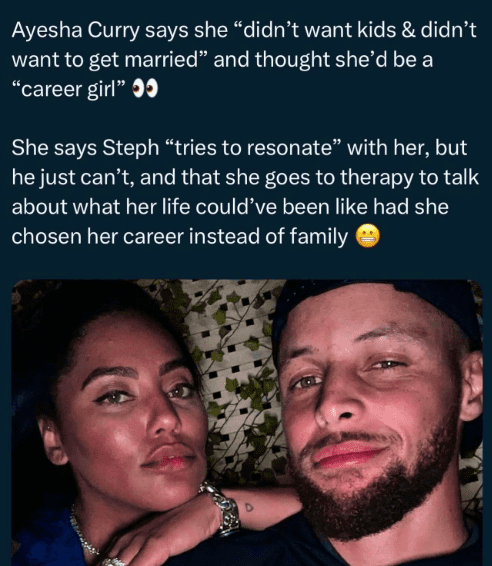
This part of her story is ignored by the backlash because it is inconvenient. It shows a woman not diminished by her family, but empowered and defined by the very challenges that supposedly limit her. It proves that the “career girl” and the “young mom” are not mutually exclusive identities, but can be fused into a singular, formidable force.
The Dignified Silence: Why Not Clapping Back Is the Ultimate Power Move
In the face of a viral storm demanding a response, Ayesha and Steph Curry’s choice to not directly address the backlash is a masterclass in modern boundary-setting and narrative control.
A public rebuttal would have done three damaging things: First, it would validate the non-issue as a legitimate controversy worthy of their time. Second, it would force them onto the defensive on a battlefield defined by their critics. Third, it would create a permanent, searchable link between their names and this fake scandal.
Instead, they employed a strategy of action over reaction. They “let their love speak for itself” through their consistent, normal, public interactions family photos, courtside appearances, supportive social media posts. This strategy achieves several goals.
It starves the trolls. It denies the outrage the oxygen of acknowledgment, causing it to burn out faster. It reinforces their true brand as a stable, united family, making the criticism look increasingly unhinged and disconnected from reality.
Most importantly, it reclaims their narrative. By not engaging in the viral drama, they refuse to let it become a chapter in their story. They treat it as external noise, not a plot point. Their silence is not weakness; it is a towering display of confidence. It says, “Our reality is so secure, so joyful, and so real to us that we do not need to defend it against your fictional interpretations.”

In an era where every minor slight demands a tweet, their dignified silence is the loudest, most powerful statement they could make. It proves that the strongest foundation for a public life is not a perfect, faultless story, but a private, unshakable truth. And theirs, as Ayesha tried to explain in her own complex way, is built on something far stronger than a pre-written bingo card. It’s built on choice, adaptation, and a love that was strong enough to embrace a beautiful surprise.