KD’s Verdict: LeBron Just Figured It All Out
In the relentless, championship obsessed culture of the NBA, where legacies are often reduced to a simple count of rings, Kevin Durant has always been a philosopher of the craft. He speaks in the language of skill, of footwork, of the subtle art of getting to a spot and rising up. So, when he sits down with his Houston Rockets teammate Fred VanVleet on the “Unguarded” podcast and delivers a verdict on LeBron James, it demands attention not for its controversy, but for its profound insight. “I feel like LeBron’s still getting better at his game, man. It’s crazy,” Durant begins, before landing the conceptual bombshell. “I just feel like he just recently mastered his game.” The statement hangs in the air, seemingly paradoxical.
How can a player with over 40,000 points, four championships, and two decades of dominance only now be considered a master? Durant’s observation is not about accumulation; it is about culmination. He is pinpointing the moment when unparalleled physical talent finally fused completely with an all-encompassing, intellectual command of the sport. According to one of the game’s purest technicians, LeBron James, at an age when most legends are long retired, has just completed his final and most impressive evolution: the transformation from a force of nature into a master of the art.
To decode Durant’s statement is to first understand his personal basketball ethos, which rejects the simplistic tyranny of “ring culture.” For Durant, the highest form of basketball achievement is not a trophy held aloft in June, but a lifetime spent in pursuit of an unattainable perfection. “Championships is cool, that matters,” he concedes, “but mastering the game and actually having actual production for a long period of time at the highest level, playing meaningful games… this s—t matters to me.”
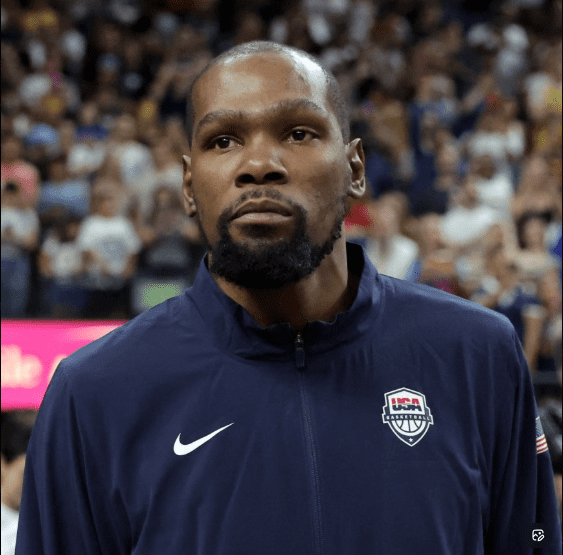
His personal pantheon reflects this. He names Kobe Bryant, Michael Jordan, Kevin Garnett, Tracy McGrady, and Tim Duncan a list that values Garnett’s ferocious two-way intensity and McGrady’s poetic scoring artistry as highly as Duncan’s five titles. It is a list about the how, not just the how many. Within this framework, his comment on LeBron becomes clear. Mastery, for Durant, is the end point of a skill journey. It is when a player’s understanding of the game, their technical toolbox, and their physical capability achieve a state of perfect synergy, allowing them to dictate terms to the defense regardless of age or athletic decline. He is saying that LeBron, for all his prior greatness, has only just arrived at that particular summit.
The evidence for this late career mastery is not found in a single highlight, but in a deliberate, statistical reinvention of his offensive identity. The young LeBron was a breathtaking marvel of physics a 6’9″, 250-pound locomotive who could outrun guards and overpower centers. His game was built on a foundation of rim attacks, relentless in transition, and a passing vision that exploited the defensive collapses he caused. The three-point shot was a tool, not a weapon. The post up was a physical mismatch, not a skilled operation.
The turning point was the inevitable conversation with Father Time. As his otherworldly burst and vertical explosion began a gradual descent from “superhuman” to merely “elite,” LeBron faced a choice: descend with his athleticism or ascend with his mind. He chose the latter, embarking on a conscious project of skill acquisition that would redefine his game. The results are quantifiable. After nearly two decades as a 34.5% career three point shooter, LeBron has undergone a shooting renaissance.
In the seasons since turning 36, he has consistently shot above 36% on high volume, including a career best 41.0% in the 2023-24 season. This is not variance; this is reconstruction. Similarly, he has developed a fall away jumper, particularly from the mid-post, that has become one of the most efficient and unblockable shots in the league. He is no longer just beating defenders; he is intellectually disassembling them with a mature, calculated arsenal designed for maximum efficiency with minimal physical expenditure.
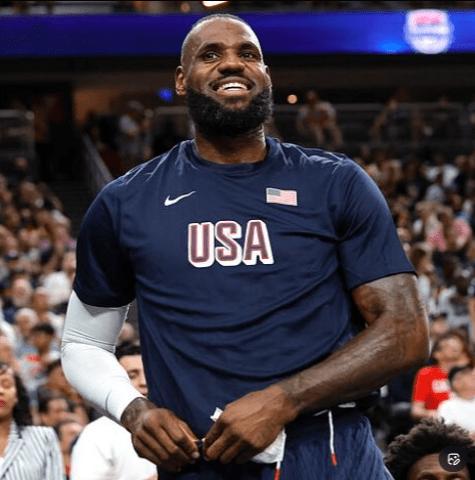
This evolution represents the core of what modern analysts and players call the “old man game.” It is not a decline; it is an advanced degree in basketball economics. Fred VanVleet echoed Durant’s sentiment perfectly: “His old-man game is crazy.” This style prioritizes footwork over foot speed, angles over athleticism, and pace over power. LeBron now operates as a cerebral conductor from the top of the key or the mid-post. He uses hesitations, shot fakes, and shoulder dips to keep defenders off balance. He has mastered the art of using his body as a shield, creating just inches of space that are all he needs to release his perfected jumper.
His passing, always elite, has become even more prescient, as he now anticipates rotations before they even form. He expends energy in precise, calculated bursts, often conserving his legs on defense to unleash a critical offensive possession. This is the game Durant is referring to a game stripped of superfluous movement, where every action has a purpose, and every skill is deployed with the cold efficiency of a grandmaster moving a chess piece. The athletic freak has been replaced by the basketball savant.
Durant’s perspective forces a dramatic reevaluation of LeBron James’s career arc. The traditional narrative plots a steady rise to a peak (often his 2012-2013 MVP seasons), followed by a sustained plateau of excellence. Durant’s analysis suggests a different graph: a long, upward trajectory of skill and understanding that peaks after the physical prime. In this view, the championships in Miami and Cleveland were won by a phenomenal basketball player operating at the height of his physical powers. The mastery displayed in Los Angeles, particularly in his late 30s, is the work of a complete basketball intellect who has solved the game on a conceptual level.
It reframes his longevity from a mere marvel of health into an unprecedented intellectual achievement. He isn’t just lasting; he is evolving past his previous iterations. This places his 40,000 point milestone and his continued All-NBA selections in a new light. They are not just records of accumulation but testaments to a player who refused to let his game fossilize, who continued to add chapters to his own manual long after the standard edition was published.

The implications of Durant’s “mastery” standard ripple across how we assess basketball history. It inherently values the career of a Karl Malone or a Charles Barkley players who refined devastating skills over nearly two decades differently than the ring count methodology does. It also adds a fascinating layer to the legacies of current stars. Durant himself, averaging 25.3 points on 50.9% shooting at age 37, is clearly walking his own path of skilled longevity.
Ultimately, Kevin Durant has provided the basketball world with the most sophisticated lens through which to view the twilight of LeBron James. He has moved the conversation beyond debates about the “GOAT” and into an appreciation of the craft itself. To say LeBron recently mastered the game is to say that his greatest accomplishment may not be the titles he won in his 20s and 30s, but the profound, skilled basketball genius he engineered in his 40s. It is the story of an immortal who finally became a complete master of his own domain. In the end, Durant’s comment is the highest compliment one artisan can pay another: I see the work you put into your craft, and I recognize the moment you perfected it. For LeBron James, that moment is now.