From Nerve Damage to NBA Star: The Brace You Never Noticed
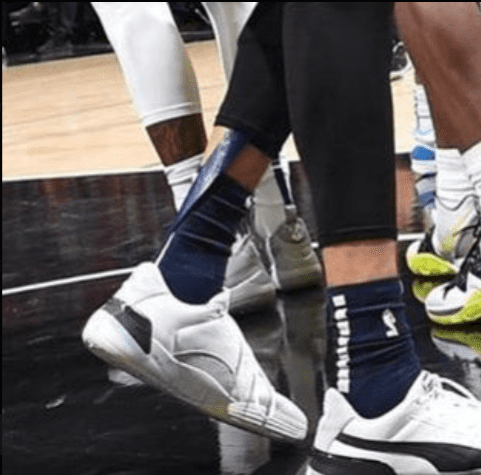
Every night, as Michael Porter Jr. laces up for the Denver Nuggets, he performs a ritual unseen by millions of fans. Before pulling on his jersey and stepping onto the court where he’s become one of the league’s most lethal shooters, he secures a hidden device a custom, carbon-fiber brace called an Ankle Foot Orthosis (AFO). To the untrained eye, it’s invisible, tucked discreetly under his sock. But for Porter, it is the single most important piece of equipment he owns. It isn’t for performance enhancement; it’s for basic neurological function.
This AFO brace isn’t typical sports gear; it’s a medical apparatus designed for elderly patients recovering from strokes or severe nerve damage, engineered to prevent a person’s foot from dragging on the ground. For Porter, a 26-year-old athletic marvel, it’s the reason he can walk, run, and chase the title of best shooter in the world. The story of Michael Porter Jr. is not just one of talent and triumph. It is a story of profound medical resilience, of playing through a condition that would end most careers, and of the secret brace that allows him to defy a body that once betrayed him.
The Injury That Almost Ended It All: A Back Fracture’s Devastating Chain Reaction
Michael Porter Jr.’s battle begins not with his ankle, but with his spine. Coming out of high school as the nation’s top recruit, Porter was a 6’10” scoring phenom, a fluid athlete with a picture-perfect jump shot destined for the #1 overall pick in the 2018 NBA Draft. Then, disaster struck. During his lone college season at Missouri, he suffered a lower back injury initially diagnosed as a hip sprain. The truth was far worse: a L3-L4 spinal disc herniation that required a microdiscectomy surgery. This first surgery was just the opening act of a medical nightmare. The initial procedure didn’t take, leading to a second, more invasive surgery just months later a lumbar fusion, where two vertebrae are permanently welded together with rods and screws to stabilize the spine.
It was this second, life-altering surgery that caused the neurological deficit Porter lives with today. The trauma and swelling from the operation damaged the nerves running from his spine down his left leg a condition known as “foot drop.” Foot drop means the muscles that lift the front of the foot are paralyzed or severely weakened. Without the ability to dorsiflex (pull his toes up toward his shin), his left foot would slap down or drag with every step. For an elite athlete whose game was built on movement, cutting, and jumping, this was a potential death sentence. The back issues robbed him of his rookie year and caused him to plummet in the draft, where the Denver Nuggets took a historic gamble on him with the 14th pick. But the nerve damage threatened to take away the very act of playing. He could rehab his back, but the foot drop was, and remains, a permanent condition.
The Secret in His Sock: An AFO Brace’s Life-Changing Support
This is where the Ankle Foot Orthosis (AFO) becomes the hero of the story. An AFO is a rigid brace, typically made of plastic or carbon fiber, that runs from just below the knee down the calf and under the foot. Its primary function is to hold the foot at a 90 degree angle to the leg, mechanically preventing it from dropping. It’s a common device for stroke survivors, multiple sclerosis patients, or those with peroneal nerve injuries. For Porter, it is not an accessory; it is a necessity for basic athletic movement.
The custom-built AFO he wears is a masterpiece of medical engineering, designed to be as lightweight and unobtrusive as possible while performing a critical job. “I still feel fully pain from it,” Porter has admitted, acknowledging the constant reminder of his limitation. Without it, he would literally trip over his own foot when running. He wouldn’t be able to properly push off for a jump shot or stabilize himself on a defensive slide. The brace provides the structural support his nerves cannot, allowing for a more normal gait and function. It’s the difference between a career and a medical retirement. Every explosive drive to the basket, every graceful fadeaway jumper, every step he takes on defense is facilitated by this hidden piece of equipment. It is the silent guardian of his NBA dream.
A Mental and Physical Battle: Embracing the “Reminder”
Adapting to the AFO was as much a psychological war as a physical one. Porter has spoken candidly about the deep frustration he initially felt. “I used to dread putting on the brace,” he has said. The resistance was twofold. First, it physically limited his freedom. Even the most advanced AFO creates a degree of stiffness, altering natural proprioception and feel. For a player of his caliber, any restriction is a source of anxiety. Second, and more profoundly, it was a daily, tactile reminder of loss. Lacing up the brace was a ritual that forced him to confront the pristine athleticism he had as a teenager, now permanently altered. It symbolized what was taken from him.
Over time, however, his perspective transformed. The dread turned into gratitude. The brace was no longer a shackle but a key. “Before each game, he thanks God that such an apparatus exists,” a source close to Porter noted. He began to see it not as a mark of weakness, but as a tool of empowerment. It allowed him to access his talent. This mental shift was crucial. Instead of being weighed down by the “reminder,” he accepted it as part of his identity the price of admission to the career he loved. This resilience defines him. He isn’t playing despite the brace; he’s playing because of it. It is the ultimate symbol of his adaptation and refusal to be defined by injury.
Redefining Greatness: The NBA’s Most Unique Superstar
Michael Porter Jr.’s journey redefines what it means to be an NBA superstar. His game is a breathtaking paradox. He is one of the purest, most efficient high-volume shooters on the planet, a 6’10” forward with a release so quick and high it’s virtually unblockable. He is a critical third star for the defending champion Denver Nuggets, providing the elite floor-spacing that unlocks Nikola Jokic’s genius. Yet, he achieves this while playing with a neurological deficit that requires a brace from the geriatric ward.
This reality forces a reassessment of his defensive limitations, which critics often cite. Yes, his lateral movement can be challenged. But understanding that he navigates the court with an AFO reframes that critique into awe. That he is even a passable defender at the NBA level is a medical miracle. His story isn’t one of overcoming injury to return to 100%; it’s about forging a new 100% from a body operating at a permanent deficit. He isn’t just an inspiration for coming back from back surgeries; he’s an icon for thriving with a permanent disability in the most athletic league in the world. He has turned a piece of medical equipment into his secret superpower, proving that greatness isn’t about perfect physiology, but about perfecting what you have.