BOXING’S BRUSH WITH TRAGEDY: INSIDE THE MIRACULOUS SURVIVAL OF ANTHONY JOSHUA AND THE DEADLY CRASH THAT CLAIMED TWO LIVES
The air on the Lagos Ibadan expressway on Monday morning was thick with more than just the usual Nigerian humidity. It was heavy with the metallic scent of fate, with the echoes of screeching tires that would never be heard, and with the silent prayers of a family awaiting their champion’s homecoming. For Anthony Oluwafemi Olaseni Joshua, a man who has made a career of controlling chaos within the 20 by 20 foot square of a boxing ring, control was violently wrested away on a sun-baked stretch of asphalt known locally as “the killer road.”
In a horrific collision that left a Lexus SUV resembling a crushed aluminium can and a stationary truck with a cavernous dent in its side, two lives were tragically extinguished. Yet, from the epicenter of this twisted metal and shattered glass, the two time unified heavyweight champion of the world emerged. Rescued alive. Conscious. With what authorities would later call, almost unbelievably, “minor injuries.”
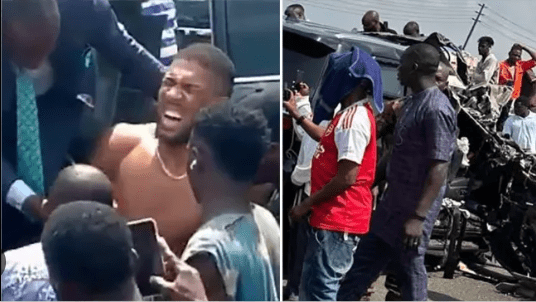
The images hit social media with the force of a Joshua right hook: the boxer, topless, dazed, sitting in the back of another vehicle, his famous Nigeria continent tattoo visible on his shoulder as he stared blankly ahead. Around him, the glitter of broken window glass looked like fallen stars. This was not the gladiator who had dismantled Jake Paul just days prior under the Miami lights for a share of £210 million. This was a man, vulnerable and stunned, pulled from the jaws of a tragedy that had already consumed others.
HOW DOES FORTUNE SPARE ONE MAN IN THE MIDST OF SUCH DEVASTATION? This story is more than a traffic report. It is a profound exploration of legacy, of the dangerous roads that connect a diaspora to its homeland, and of the thin, fragile line between global celebrity and mortal peril. The journey from the pinnacle of sporting glory to a roadside nightmare is a path no one anticipates, and its aftermath will echo through the halls of boxing and the heart of Nigeria forever.
CHAPTER 1: THE KILLER ROAD A JOURNEY HOME ON NIGERIA’S MOST INFAMOUS HIGHWAY
To understand the accident is to first understand the road. The Lagos Ibadan expressway is not merely a strip of pavement; it is a pulsating, chaotic, and often deadly artery that embodies both Nigeria’s immense economic energy and its infrastructural anguish.
Spanning 127 kilometers (79 miles) between the continent’s largest megacity and the historic capital of Oyo State, this highway is a necessary gamble for millions. For Anthony Joshua, it was the final leg of a pilgrimage he makes most years a journey from Murtala Muhammed International Airport in Lagos to the family heartland in Sagamu, Ogun State. It is a trip from the global stage to ancestral soil.
But in the festive season, this already treacherous corridor transforms into a perfect storm of peril. “It gets particularly busy during this time of year as many Nigerians travel back to the country from the diaspora to celebrate the festive period,” noted BBC Africa correspondent Mayeni Jones. The volume soars. Battered trucks overloaded with goods vie for space with speeding luxury SUVs, overcrowded buses, and commercial motorcycles weaving through gaps that barely exist. Fatigue, urgency, and sometimes a competitive edge to beat the infamous traffic jams lead to risk taking.
Local media outlets have repeatedly labeled it one of Nigeria’s deadliest roads, a grim statistic borne out by regular headlines of mass casualty accidents. Poor lighting, erratic driving, inadequate enforcement, and sections in perpetual states of repair and disrepair all contribute. For Joshua’s convoy, traveling on this Monday morning, the danger was an ambient fact of life, a background risk accepted to reach home. That risk would soon crystallize into catastrophic reality.

THE SPECIFIC LOCATION OF THE CRASH TELLS ITS OWN TALE. The Ogun State Police Command pinpointed it: along the Lagos Ibadan expressway, just before a Danco petrol station near the Sagamu Interchange. This area, a nexus pointing toward his destination, is often a zone of increased activity, with vehicles slowing to exit or accelerating to continue on. It is a place of transition. For the Lexus carrying Joshua, it became a place of no return for two of its occupants.
CHAPTER 2: “BEYOND THE SPEED LIMIT” THE 90 SECOND SEQUENCE OF CATASTROPH
The official narrative from the Federal Road Safety Corps (FRSC) is chilling in its clinical brevity. It reconstructs a sequence of events measured not in minutes, but in split-second decisions with eternal consequences.
Authorities confirmed five adult males were in the Lexus SUV. Joshua was in the back, behind the driver a position often considered safer. According to eyewitness Adeniyi Orojo who spoke to The Punch newspaper, “There was also a passenger sitting beside the driver, making four occupants in the Lexus that crashed. His security detail was in the vehicle behind them before the crash.” This Pajero, carrying his security team, was following the champion’s vehicle.
The FRSC stated the Lexus was suspected to be traveling “beyond the legally prescribed speed limit.” On a road where flow is often dictated by audacity, speed is a common currency. Then came the fateful maneuver. “The car lost control during an overtaking manoeuvre,” officials reported. In an attempt to pass slower traffic, the driver committed the vehicle to a lane of oncoming traffic or a narrow gap.
WHAT HAPPENED IN THAT INSTANT? A misjudgment of distance? A sudden appearance of an oncoming vehicle from a blind curve? A slight over correction of the steering wheel? The investigation will seek to answer this. The result was irrevocable. The speeding Lexus, now unstable, veered off its path and smashed into the rear or side of a massive stationary truck parked on the road’s shoulder.
The physics were merciless. The stationary truck, a behemoth of immovable mass, acted as a concrete wall. The Lexus, a projectile of speed and momentum, underwent rapid, violent deceleration. The passenger cabin, where Joshua sat, was compromised. The front of the vehicle, where the driver and front passenger sat, absorbed the apocalyptic force. The two men in those seats bore the brunt of energy that no human body is designed to survive. They were killed instantly.
The security vehicle trailing behind arrived at a scene of unthinkable horror. Their principal was in a wreck. Two men were dead. Two other passengers in the Lexus had, against all odds, escaped unhurt. And Anthony Joshua, the focal point of their protection detail, was alive but trapped in a shattered capsule of metal and glass.
CHAPTER 3: THE MIRACLE AND THE MOURNING SCENES FROM THE WRECKAGE
The first images to emerge were surreal and distressing. In one, Joshua is seen sitting in the back seat of what appears to be a rescue vehicle or the follow on security Pajero. He is shirtless, looking down, his body language a dictionary of shock. His brow is furrowed not in pain, but in a deep, processing confusion. The iconic tattoo on his right shoulder the map of Africa with Nigeria highlighted is starkly visible, a symbol of pride now witness to trauma.
Around him, the glint of safety glass covers his lap like diamond dust. This was not the sweat of a hard-fought round, but the debris of a shattered window. The photo, widely circulated, offered a raw, unfiltered glimpse into the immediate aftermath of a life altering event. This was the champion, stripped bare, in every sense.
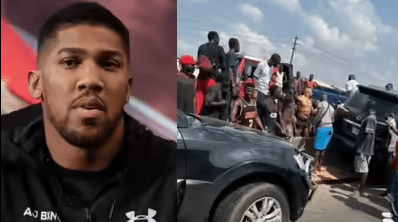
Then came the official pictures from the FRSC, which laid bare the sheer violence of the impact. One photo shows the Lexus itself. It is not just damaged; it is deconstructed. The front end is concertinaed into a grotesque sculpture, the engine block likely pushed into the space where the driver’s legs would have been. The roof is buckled. The windshield is a spiderweb of cracks surrounding a hole. It is a miracle that anyone in this vehicle survived.
A second image shows the truck, a titan with a grievous wound. A massive, deep dent is cratered into its side or rear cargo area. Around it, scattered on the ground, are pieces of the Lexus plastic trim, fragments of headlight, and piles of what looks like sand or spilled cargo. The silence in these still photos is louder than any crowd roar Joshua has ever experienced.
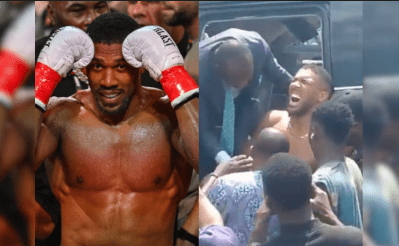
“Joshua was rescued alive and sustained minor injuries,” the FRSC report stated. He was taken for “medical attention.” The terms “rescued” and “minor injuries” did heavy lifting. They conveyed the urgency of extraction from the wreck and the astonishing fortune of his condition. The two other survivors “escaped unhurt,” perhaps in the back with Joshua or in seats that fortuitously avoided the direct crush zone.
For the families of the two deceased men, however, the news was the ultimate devastation. Their identities have not yet been publicly released, protecting them in their moment of immense grief. Were they long time friends? Trusted associates from the UK? Local Nigerian aides? Their stories, their lives, and their final moments are now forever tied to the global fame of the man who shared their car. A relative of Joshua, speaking anonymously to the BBC, acknowledged this shared tragedy with poignant grace: “We are hoping for his speedy recovery and also the people who passed away – I pray for the departed to rest in peace.”
CHAPTER 4: THE ANCESTRAL PULL – WHY JOSHUA WAS ON THE ROAD TO SAGAMU
This accident did not occur on a random highway. For Anthony Joshua, this road was a conduit to his roots, a tangible connection to a heritage he has proudly championed throughout his meteoric career.
Joshua’s identity is a harmonious blend of British and Nigerian. Born in Watford, England, to a Nigerian mother and a father of Nigerian and Irish descent, he has never let the world forget where his family’s heart lies. His great-grandfather, Daniel Adebambo Joshua, was a wealthy landowner and merchant in Sagamu. The family name carries weight in that community, tracing back generations.
“The Joshua family is well known in Sagamu, in south-west Nigeria, and traces its ancestry there across several generations,” the BBC profile noted. This is not a celebrity paying lip service; it is a man grounded in a specific place. His tattoo is the most permanent and public declaration of this pride. In the ring, the Nigerian flag flies alongside the Union Jack. After victories, he has often wrapped himself in both.
His role in Nigeria is active, not passive. He is a sports ambassador for Ogun State. There are concrete plans to build a new indoor boxing venue named after him, a legacy project intended to inspire the next generation of Nigerian fighters. His visits are not clandestine; they are homecomings. “He’s normally coming around for the new year,” his relative told the BBC. “We haven’t seen him so we were expecting him.”

This particular journey followed the biggest payday and one of the most scrutinized victories of his career. Just on December 19th, he stepped into the ring in Miami against the social media phenomenon Jake Paul. In a fight that divided purists but captivated a global Netflix audience, Joshua broke Paul’s jaw in two places, winning decisively. The purse was a reported £210 million. He had proven his enduring marketability and power.
From the neon spectacle of Miami to the familiar, dusty roads of Ogun State this is the rhythm of Joshua’s life. The crash violently interrupted that rhythm. It transformed a journey of celebration and homecoming into one of trauma and loss. The very road that leads him to his history nearly became the end of his story.
CHAPTER 5: THE INVESTIGATION AND THE INESCAPABLE QUESTIONS
In the wake of the crash, protocol and procedure take over. The Ogun State Police Command, under Commissioner Lanre Ogunlowo, immediately announced an investigation had been ordered. “I can confirm to you that an accident occurred and the victim has been taken to the hospital,” Ogunlowo stated, his words measured for the press.
The Divisional Police Officer in Sagamu, Ode Fredrick, was more direct, telling the BBC his team was “heading to the hospital to confirm the casualties.” This is the grim, logistical follow up: identifying the deceased, formally recording Joshua’s injuries, and taking statements from the survivors and the security team.
The Federal Road Safety Corps, having secured the scene and documented the wreckage, will piece together the forensics. They will look for skid marks, measure impact angles, and inspect the vehicles. They will seek to verify the speed estimate. Crucially, they will seek to determine why the large truck was stationary on the side of the expressway. Was it parked legally? Was it broken down? Were its hazard lights activated? These factors could influence the final apportioning of blame.
BUT BEYOND THE OFFICIAL DOCKET, BIGGER, MORE UNCOMFORTABLE QUESTIONS HOVER:

- The Security Protocol: Why was the champion’s vehicle performing a high speed overtaking maneuver? Should the lead car not have been more cautious, with security dictating a conservative, defensive driving style? Was there pressure to make good time on a busy road?
- The Perennial Nigerian Plague: This accident instantly became a symbol of Nigeria’s road safety crisis. How many more must die on the Lagos Ibadan road before comprehensive, sustained solutions better enforcement, driver education, road maintenance, emergency services are implemented? Joshua’s fame casts a glaring light on a daily tragedy for ordinary Nigerians.
- The Psychological Toll: What is the “minor injury” to Joshua’s psyche? To witness death so closely, to be extracted from a wreck that killed others, to grapple with the sheer randomness of survival this leaves scars no MRI can detect. How will this experience reshape the man, the fighter?
For now, Joshua is in an undisclosed hospital, receiving care. His family is in shock but grateful. The boxing world holds its breath. And two families are beginning the unimaginable process of mourning loved ones whose deaths are now an international headline.
CHAPTER 6: THE FIGHTER’S METTLE – WHAT COMES NEXT FOR ANTHONY JOSHUA?
Anthony Joshua is no stranger to adversity. His career is a rollercoaster of spectacular highs and soul crushing lows. He rose to unified champion, lost shockingly to Andy Ruiz Jr., climbed back to reclaim his titles in a display of mental fortitude, and then lost them again to Oleksandr Usyk. He has been written off and resurrected multiple times.
THIS, HOWEVER, IS A DIFFERENT KIND OF FIGHT. This is not an opponent he can study on film. There is no game plan, no trainer in his corner, no bell to signal the end of a round. The trauma of a near fatal accident operates on its own timeline.
The immediate concern is his physical recovery. “Minor injuries” in such a context could still mean lacerations, severe bruising, whiplash, concussion, or broken ribs. The force required to destroy a vehicle like that transmits through the body in unpredictable ways. His medical team will be thorough, knowing the future demands on his physique.
Then comes the inevitable period of reflection. Joshua is a deep, philosophical thinker about his life and career. He has spoken openly about therapy, about the pressures of fame, about finding peace. This event will force a reckoning with mortality and purpose. The £210 million from the Paul fight means financial pressure is gone. What now drives him? Will the urge to compete burn as brightly? Or will the perspective gained from this brush with death alter his ambitions?

The world of boxing will wait. Promoters, rivals, and fans will all speculate. But for once, the relentless machine of sports hype will likely pause, affording a man some dignity and space to heal. His legacy, already significant, now has this incredible chapter of survival etched into it.
Finally, there is his relationship with Nigeria. This accident happened on Nigerian soil, on a road traveled by millions of his countrymen. Will it frighten him away, or will it deepen his commitment to be part of the solution? Could Anthony Joshua, survivor, become a powerful voice for road safety reform in a nation that adores him? It would be a profound way to honor the two men who died beside him.

The final bell on this ordeal has not rung. Recovery is a fight. Healing is a fight. Making meaning from tragedy is the hardest fight of all. If history is any guide, Anthony Joshua has the heart of a warrior. But even warriors need time to tend their wounds.
THE ROAD TO SAGAMU WAS MEANT TO LEAD HOME. INSTEAD, IT LED TO A CROSSROADS BETWEEN LIFE AND DEATH, BETWEEN CELEBRATION AND MOURNING. Anthony Joshua walked away. Two others did not. In that stark difference lies a story that will haunt and inspire, a reminder that fame is no shield against fate, and that sometimes, the most powerful victories happen far from the roar of the crowd, in the silent, grateful beat of a surviving heart.