THE $61,000 AI CATFISH:
The studio lights were bright, the microphones were hot, and Gilbert Arenas was about to lose his mind. As his co-host, Josiah Johnson, began reading the details of a shocking story, Arenas’ face contorted into a masterpiece of disbelief. The subject? His former NBA rival and podcasting colleague, Matt Barnes, had allegedly been swindled out of a staggering $61,000. The perpetrator wasn’t a shady bookie or a corrupt financial advisor.
It was an “AI snow bunny.”
Arenas leaned back, his mouth agape, before erupting with a mix of shock and unfiltered hilarity. “That man just got finessed out of sixty-one thousand dollars? By an AI snow bunny? Nah, y’all playing. Nah, I don’t believe it,” he blurted out on his show. The phrase “AI snow bunny” slang for an attractive, seemingly white woman who is, in this case, entirely synthetic would soon echo across social media, perfectly encapsulating the bizarre, terrifying new reality of digital deception.
But this was more than just a hilarious clip for the timeline. Matt Barnes’ story, which resurfaced in late 2025, is a harrowing case study in 21st century extortion. It involves deepfake audio, fabricated videos, threats to a pregnant partner, and a panicked payout to a ghost. For Arenas, it was a comedy bit. For Barnes, it was a “bullsh-t” nightmare that highlights how artificial intelligence has weaponized personal scandal, turning private moments into public shakedowns with terrifying efficiency.
HOW DOES A TOUGH NOSED, 14 YEAR NBA VETERAN GET SCAMMED OUT OF A LUXURY CAR’S WORTH OF CASH BY A COMPUTER GENERATED ILLUSION? And what does his story reveal about a world where seeing and hearing is no longer believing? Strap in. The future of fraud is here, and it just cost Matt Barnes sixty one grand.
“SHOW ME SOMETHING REAL”: ARENAS’ COMIC DISBELIEF VS. BARNES’ DIGITAL HELL
Gilbert Arenas’ reaction is the visceral, human response to something that feels like science fiction. His breakdown was a riot of logic and street sense applied to an illogical situation.
“If I’m paying sixty thousand, I’m getting whatever you’re selling,” Arenas declared, laying out his uncompromising barter system. “It ain’t gonna be no ‘hey, pay me to shush.’ I’m the only person that can’t get caught by AI like that. You gotta show me something real.”
For Arenas, the entire premise was absurd. The value proposition made no sense. You don’t pay a massive sum to prevent the receipt of a product; you pay to receive it. His disbelief peaked when Johnson detailed the sophistication of the scam: “If she did all that, she got to have pictures or something now… How you get catfished like that?”
But therein lies the terrifying rub of modern AI scams: they don’t need “real” pictures anymore. They can generate them. Barnes wasn’t dealing with a clumsy 2012-era catfish using a model’s stolen photos. He was allegedly dealing with a malicious actor using generative AI tools to create synthetic media—”deepfakes”—designed specifically to impersonate and entrap him.
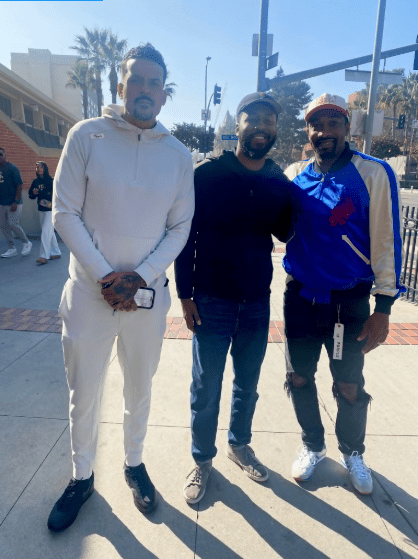
Barnes’ own explanation, posted on Instagram, paints a picture of a sophisticated, multi-layered attack. He claimed it began during a brief 2023 split from his fiancée, model Anansa Sims. He communicated with a woman who, after he reconciled with Sims, turned hostile. What followed were threats from spoofed numbers, but crucially, they were accompanied by “AI-generated material” likely fabricated texts, voice notes, or even video snippets that made it appear Barnes had been unfaithful in a damning way.
The scammer’s leverage was diabolical: Sims was pregnant. Fearing the stress and potential fallout from these convincing fakes, Barnes says he made a series of payments totaling $61,000 to a person named “Zoe” to buy silence. It wasn’t payment for a product. It was a desperate ransom paid to protect his family from a digital phantom.
THE DEEPFAKE PLAYBOOK: HOW THE $61,000 SCAM LIKELY WENT DOWN
While Barnes has kept specific details private, cybersecurity experts can reconstruct the likely playbook used in such a high-stakes “AI sextortion” scheme. This wasn’t a random attack; it was a targeted, psychological operation.
Phase 1: The Hook & The Material. The scammer, using a fabricated social media profile (the “AI snow bunny”), initiates contact. During casual conversations, they may use AI voice cloning tools to have spoken conversations, building legitimacy. They may also encourage the target to send mundane photos or voice messages. These become the “seed” data. Using generative AI, the scammer can then create “deepfake” nudes or compromising videos by swapping the target’s face onto someone else’s body. They can fabricate incriminating text conversations.
Phase 2: The Panic Button. Once the target (Barnes) disengages, the scammer unleashes the fakes. They send samples a blurred deepfake image, a clipped audio snippet of a fabricated argument. The message is clear: “I have proof of your infidelity. I will send it to your pregnant fiancée and blast it everywhere.” The threat feels credible because the evidence, though fake, looks and sounds real.
Phase 3: The Pressure Cooker. The scammer applies relentless pressure, exploiting the emotional vulnerability of the moment (a pregnant partner, a public image). They use burner apps and spoofed numbers to seem like a relentless network, not a single person. They create an artificial urgency: “Pay now, or it goes public in one hour.”

Phase 4: The Payoff & The Ghost. Payments are demanded via untraceable methods like wire transfer, cryptocurrency, or gift cards. Once the money is received, the scammer vanishes. The “Zoe” who received the money is an untraceable financial mule or a fabricated identity. The victim is left poorer, traumatized, and often too embarrassed to go to the authorities exactly as designed.
Barnes’ decision to pay was, in this frightening context, a rational choice made under digital duress. He wasn’t paying for silence about a real affair; he was paying a ransom to stop the distribution of a synthetic, but devastatingly convincing, lie.
THE LEGAL BLACK HOLE: CAN YOU SUE A GHOST?
Furious and publicly humiliated, Matt Barnes vowed to fight back. But his target highlights another modern dilemma: who do you sue?
Barnes announced plans to sue popular YouTuber Tasha K for posting what he called the AI generated material. This is a strategic, if indirect, legal move. It’s easier to target a platform or publisher that amplified the harm than to find the anonymous, likely overseas, individual who created it. Laws against revenge porn and defamation exist, but they are scrambling to catch up to technology that fabricates the “porn” and the “facts” out of thin air.

The legal system is woefully unprepared. Deepfakes exist in a gray area. Is a fabricated video of someone committing a crime defamation? Absolutely. Is it fraud? Possibly. Is it a digital forgery? A new category of crime may be needed. Proving in court that media is AI-generated requires expensive digital forensic experts, and the technology to create fakes is improving faster than the technology to detect them.
For every public figure like Barnes, there are countless ordinary people being targeted. The FBI has issued warnings about the explosion of “sextortion” schemes using AI. Teenagers are being coerced after sharing innocent selfies that are then morphed into explicit content. The emotional and psychological toll is immense, leading to depression, anxiety, and in tragic cases, suicide.
Barnes’ case is a high profile warning siren. If a savvy former pro athlete with resources can be bled for $61,000, no one is safe. The scam doesn’t require technical genius; the tools are available for cheap on dark web forums. It only requires psychological cruelty and a willingness to weaponize technology.
ARENAS’ FINAL WORD: A SURVIVAL GUIDE FOR THE DEEPFAKE ERA
Beneath Gilbert Arenas’ comedy was a crude but effective survival guide for the new digital wilderness. His principles, while delivered for laughs, are becoming essential rules for personal security.
- The “Show Me Something Real” Principle: Extreme skepticism is the new default. Any unsolicited, too good-to-be-true interaction online is a red flag. Assume personas are fabricated until proven otherwise through real-world, verifiable interaction.
- The “Value for Money” Axiom: Never, ever pay to suppress information. As Arenas stated, paying a blackmailer only proves you can be bled and invites more demands. It is a bottomless pit. The moment a financial demand is made, it’s confirmation of a scam.
- The “I Can’t Get Caught” Mindset (The Right Way): Arenas joked about his own immunity, but the lesson is to minimize your attack surface. Be fiercely protective of your personal data photos, voice notes, videos. Assume anything digital can be copied, stolen, and manipulated.
- Immediate Action Protocol: If threatened with deepfakes, do not engage. Do not pay. Document everything. Screenshot threats and accounts. Report the profile to the platform immediately. And most importantly, go to the authorities and your closest loved ones first. Transparency defangs the blackmailer’s primary weapon: secrecy and shame.
Matt Barnes’ $61,000 lesson is one of the most expensive ever delivered. It’s a landmark case that sits at the intersection of technology, psychology, and crime. It proves that our digital doubles can be weaponized against us, that our own faces and voices can be turned into evidence for crimes we didn’t commit.
Gilbert Arenas laughed because the alternative is to scream in terror. The “AI snow bunny” isn’t just a funny phrase; it’s the face of a new kind of predator one that doesn’t exist, but can still rob you blind.
In a world where anyone can be perfectly forged, what is the true currency of trust, and how do we protect it before the next victim pays an even higher price?