TWO LIVES LOST, A CHAMPION’S WORLD SHATTERED
Ten days ago, Anthony Joshua stood victorious under the bright lights of a Miami ring, his hand raised after a knockout win over Jake Paul. The future, with a long anticipated showdown against Tyson Fury finally on the horizon for 2026, seemed brighter than ever. This Monday morning, that future was violently rewritten on a deadly stretch of Nigerian highway. Now, the two time heavyweight champion finds himself not in a training camp, but in a hospital bed, grappling with minor injuries and the immeasurable grief of losing two men he called both colleagues and brothers.
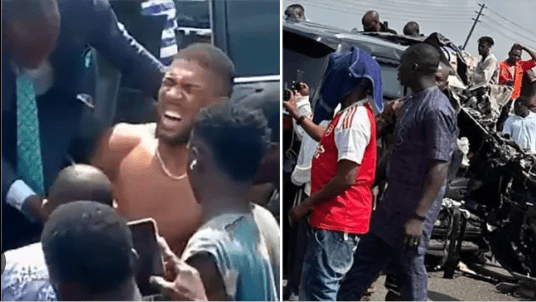
A routine journey to visit family for the New Year turned into a scene of horror. Joshua was a passenger in a Lexus SUV traveling on the notoriously dangerous Lagos-Ibadan expressway when the vehicle collided with a stationary truck. Preliminary investigations point to a lethal combination of excessive speed and a burst tire during an overtaking maneuver. While Joshua and the driver were rescued from the wreckage, the two passengers seated on the vehicle’s right side Sina Ghami and Latif “Latz” Ayodele were pronounced dead at the scene.
In an instant, triumph was replaced by tragedy. The boxing world, so often defined by rivalry and bravado, has united in a somber chorus of condolence. Promoter Eddie Hearn paid tribute to “two great men”. Even recent opponent Jake Paul set aside competition, stating, “Life is much more important than boxing”. For Joshua, the physical pain of “minor bruises” is eclipsed by the profound emotional trauma of the loss. As he spends a second night under observation in a Lagos hospital, surrounded by family including his mother, the road ahead is no longer about fights or titles, but about healing from a wound that no championship belt can ever conceal.
HOW DOES A FIGHTER, TRAINED TO CONQUER ADVERSITY IN THE RING, BEGIN TO PROCESS A LOSS THAT OCCURRED FAR FROM THE SPOTLIGHT? The story of Anthony Joshua’s crash is a devastating reminder that life’s most brutal blows can come when we least expect them, leaving even the strongest among us to pick up the pieces.
“TWO GREAT MEN”: THE IRREPLACEABLE LOSS OF SINA GHAMI AND LATIF AYODELE
To understand the depth of Joshua’s loss, one must understand who Sina Ghami and Latif Ayodele were. They were not mere employees; they were foundational pillars of “the Anthony Joshua machine,” integral to his daily life for over a decade.
Sina Ghami was Joshua’s strength and conditioning coach, a constant presence through the highest peaks of his career. He was the architect behind the physical prowess that carried Joshua to an Olympic gold medal and two world heavyweight titles. Ghami co-founded the Evolve gym in London and had worked with elite athletes across the NFL and NBA, but his primary focus was Joshua. Just weeks ago, he was in Joshua’s corner in Miami, celebrating the victory over Jake Paul. His final social media post was a story from Lagos, a haunting glimpse of normalcy before the crash.
Latif “Latz” Ayodele was Joshua’s personal trainer and a close spiritual confidant. His passion for fitness was matched by his devotion to Islam, which he called his “biggest blessing”. Hours before the fatal journey, the world saw a video of Joshua and Ayodele locked in a playful game of table tennis, a moment of pure camaraderie now frozen in time. Ayodele’s Instagram profile features a young, fresh-faced Joshua from the early days, a testament to a journey they shared from the very beginning.

Their deaths create a void that extends far beyond the gym. “They’ve been with him, if not from the start, at least very early on… They are with him all the time,” boxing expert Steve Bunce told the BBC. They were friends first, trusted companions who shared in the private struggles and public triumphs. The emotional impact of their sudden passing, as Sky Sports’ Andy Scott noted, is something Joshua will need “a hell of a lot of time and space to process”.
A CHAMPION’S MIRACULOUS ESCAPE: THE CRASH SCENE AND A NATION’S RESPONSE
The details of the crash paint a picture of a miraculous and narrow escape for the British-Nigerian champion. The accident occurred around 11 a.m. local time on the Lago an expressway, a major artery known as one of Nigeria’s deadliest roads, especially during the festive period when diaspora families return home.
Authorities point to speed as a critical factor. The Federal Road Safety Corps stated the Lexus was “suspected to be traveling beyond the legally prescribed speed limit” and lost control during an overtaking maneuver. Ogun State police added that a burst tire on the passenger side caused the driver to lose control, swerving into the parked truck. The driver, who has been discharged from the hospital, now potentially faces prosecution for reckless driving.
Video and photos from the scene circulated globally, showing a dazed and grimacing Joshua being helped from the demolished wreckage. Eyewitnesses described rushing to help, recognizing their “glory here in Nigeria”. Joshua and the driver were evacuated to a specialized medical facility in Lagos, where he was confirmed to be stable and conscious.

The response from Nigeria’s highest levels underscored Joshua’s stature in his ancestral homeland. President Bola Ahmed Tinubu personally called Joshua in the hospital. “I wished him a full and speedy recovery, and prayed with him,” the President posted. “AJ assured me he is receiving the best possible care”. The joint statement from Lagos and Ogun state governments confirmed that after evaluations, Joshua required no emergency intervention.
THE LONG ROAD AHEAD: PHYSICAL RECOVERY AND AN UNCERTAIN FUTURE
For now, the focus is purely on recovery. Joshua remains in a stable condition in the Lagos hospital, where he will stay for observation. His promoter, Matchroom Boxing, has asked for privacy for all affected families during this “incredibly difficult time”. The exact nature of his minor injuries and a potential discharge date have not been made public.
The tragedy casts a long shadow over what was meant to be a celebratory and pivotal time in Joshua’s career. Coming off his win against Jake Paul his first fight in 15 months the plan was to build towards a historic, long waited bout with British rival Tyson Fury in 2026. Those discussions, as promoter Frank Warren acknowledged, now feel entirely “secondary”.
The question of when, or even if, Joshua will return to the ring is unanswerable. As BBC Sport’s Kal Sajad reflected, “The emotional impact of that is impossible to measure… Whatever he decides to do next in the twilight of his career almost feels insignificant”. The mental toll of surviving a crash that killed two of his closest friends may prove a far greater challenge than any opponent he has faced between the ropes.
Beyond the boxing career, Joshua’s deep connection to Nigeria has been profoundly highlighted. He was in the country to be with family, to blend in and escape the global fame, as he has often done. His family in Sagamu expressed “great shock,” with his uncle noting how freely and closely he mingled with the community. This accident, on a road leading to his ancestral home, has inextricably linked his personal story with the broader issues of road safety in Nigeria.

Anthony Joshua has faced and overcome defeat in the ring before. But this is a different kind of fight one fought in the quiet of a hospital room and the solitude of grief, where the victory is simply finding a way to move forward.
In the aftermath of unspeakable loss, can the discipline and resilience forged in a boxing career provide a path through grief, or does this tragedy redefine what it means to be strong?