FROM MEMPHIS PROJECTS TO GEORGIA’S MR. BASKETBALL A JOURNEY THAT REDEFINED A LEGACY
The culture shock hit Lou Williams before he even unpacked his bags. Standing in Snellville, Georgia, a suburb east of Atlanta, the teenager from Memphis scanned his new surroundings. The tightly knit “village” of the projects was gone. The familiar faces, the communal safety net where “everybody’s mama is basically your mama” vanished. His first, bewildered thought cut to the core of his dislocation: “Where the snow at?”
But the real seismic shift wasn’t the missing snow flurries of a Southern winter. It was the people. “I didn’t interact with white people or Mexicans until I got to Atlanta,” Williams would reflect decades later on the “Hear Me Out” podcast. “I had never interacted with other races until I got here.”
This jarring transition, from the insular Black community of his Memphis upbringing to the sprawling, diverse metropolis of metro Atlanta, did more than just startle a high school kid. It forged him. The discomfort of being the outsider, the necessity of learning new social codes, and the challenge of proving himself on an unfamiliar stage became the foundational crucible for one of the most uniquely resilient careers in modern NBA history. Williams didn’t just move cities; he crossed into a new world, and that journey equipped him with a versatility and mental toughness that would define his 17-year reign as the league’s ultimate sixth man.
HOW DOES A KID WHO NEVER KNEW LIFE OUTSIDE HIS OWN BLOCK ADAPT TO BECOME A STAR IN A FOREIGN LAND, AND HOW DID THAT VERY STRUGGLE BECOME THE SECRET WEAPON FOR A FUTURE THREE-TIME SIXTH MAN OF THE YEAR? The story of Lou Williams is a masterclass in adaptation, where the most disorienting culture shock became the blueprint for a legendary career.
MEMPHIS: THE VILLAGE THAT RAISED A SCORER
To understand the magnitude of Williams’ move, you must first understand what he left behind. He was a product of Memphis, Tennessee, born and raised in a specific ecosystem he describes with palpable nostalgia.
“You are connected to the projects, and that’s all you got,” Williams said, painting a picture of a world that was limited in geography but boundless in community. “All your homies are right there. Your ecosystem. It’s a village. You were raised by the village… everything is right there at your reach.”
This environment bred a particular kind of toughness and loyalty. Your reputation was earned on the local court; your identity was intertwined with your neighborhood. For a young, burgeoning basketball talent like Williams, this “village” provided a cocoon of support and a hyper-competitive proving ground. The game was life, and life was contained within a few city blocks. It was all he knew a monochromatic world in terms of lived experience, where his reality was shaped entirely by the people on his corner.
This insulated upbringing offered profound strengths: a fierce sense of belonging, an unbreakable bond with his peers, and a basketball education forged in pure, undistilled competition. But it also created a specific worldview, one untouched by the diversity he would soon encounter. His move to Atlanta wasn’t just a change of address; it was a rupture of his entire universe.
When his family relocated to the Atlanta suburbs for his high school years, Williams wasn’t just switching schools. He was emigrating from his own childhood. The cultural whiplash would have broken a lesser spirit. Instead, it became the first test of the adaptability that would become his hallmark.
ATLANTA: A CRASH COURSE IN A NEW WORLD
South Gwinnett High School in Snellville was Lou Williams’ portal to a broader America. The academic and athletic opportunity was clear, but the social and cultural adjustment was a daily struggle.
The most immediate shock was demographic. Moving from the predominantly Black projects of Memphis to the diverse suburban melting pot of Gwinnett County was a visceral experience. His honest reflection “I didn’t interact with white people or Mexicans until I got here” wasn’t a statement of prejudice, but one of sheer factual reality from his former life. He was now a minority in a new way, navigating social cues, slang, and lunchroom dynamics he had no context for.
Beyond race, the entire structure of life was different. The close-quartered “village” was replaced by sprawling subdivisions and strip malls. The constant, immediate presence of his “homies” was exchanged for the more isolated, car-dependent life of the suburbs. “Where the snow at?” was a poetic, confused lament for the familiar textures of home, a symbol of everything that felt missing.
Yet, it was on the basketball court at South Gwinnett where Williams began to translate his dislocation into dominance. The court became his universal language. His game, honed in the gritty crucible of Memphis, translated explosively. He wasn’t just playing; he was proving he belonged in this new world. Under coach Roger Fleetwood, Williams embarked on a historic prep career. He led South Gwinnett to a Georgia 5A State Championship, was named a McDonald’s All-American, and was crowned Georgia’s “Mr. Basketball” twice. He finished as the all-time leading scorer in Georgia high school basketball history, a staggering achievement that announced his arrival not just as a star, but as a conquering outsider who had mastered his new domain.
The kid from the Memphis village had been forced to expand his borders. In doing so, he didn’t lose his identity; he built a new, more complex one atop it. The confidence gained from thriving amid culture shock was immeasurable. He learned to be comfortable being uncomfortable a skill that would prove invaluable in the nomadic life of a professional athlete.
THE NBA: A NOMAD’S JOURNEY AND THE BIRTH OF “LOU WILL”
Declaring for the 2005 NBA Draft straight from high school, Williams was selected 45th overall by the Philadelphia 76ers. His professional journey would be a mirror of his teenage upheaval: constant movement, requiring perpetual adaptation.
His career is a map of professional reinvention: Seven seasons in Philadelphia, a return to Atlanta, then stops in Toronto, Los Angeles (Lakers), Houston, Los Angeles again (Clippers), and finally a second stint back in Atlanta. At every destination, he was the new guy, having to learn new playbooks, new coaches, new teammates, and new city cultures. The disorientation he felt as a teen in Snellville became a recurring professional theme.
But Williams had already done the hard work. He had already mastered the art of the transition. Instead of fighting this nomadic existence, he embraced a role that epitomized adaptability: the sixth man. Coming off the bench wasn’t a demotion; it was a strategic identity that played to his strengths. He didn’t need the rhythm of a starter. He could enter any game, in any city, against any opponent, and instantly change the flow with his explosive scoring.
“I realized that you don’t have to start to have a big impact,” Williams said. “It got to the point where teams didn’t want to see me coming in.”
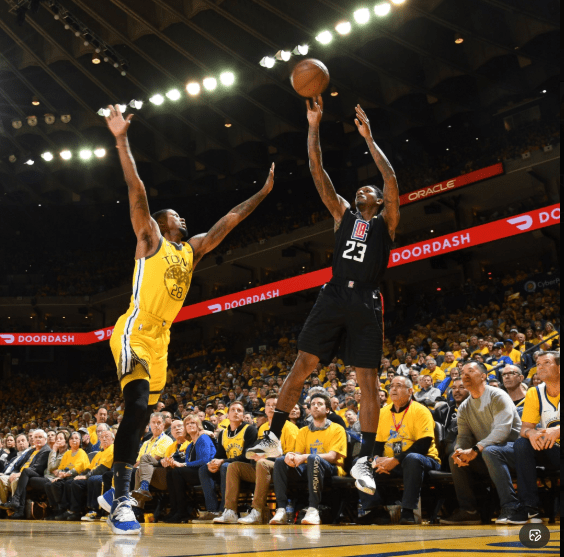
His accolades are the proof of this perfected role. He won the NBA’s Sixth Man of the Year award three times with Toronto in 2015 and with the LA Clippers in 2018 and 2019. He leaves the game as the NBA’s all-time leader in points scored off the bench, a stat that perfectly encapsulates his legacy: monumental production from a position of adaptable, ready-anywhere strength.
The “culture shock” kid had become “Lou Will,” the unwavering constant in a league of chaos. His game, like his personality, was malleable yet consistently potent. Whether in the WASP-y suburbs of Philadelphia, the glamour of Los Angeles, or the hockey town of Toronto, Williams found his footing, just as he had in that Georgia high school. His early immersion in diversity gave him a social dexterity that allowed him to connect with any locker room, a skill as crucial as his crossover dribble.
BEYOND THE COURT: THE SOCIAL CONSCIOUSNESS OF A WELL TRAVELED MAN
The perspective gained from navigating two different Americas the segregated urban village and the diverse suburban sprawl instilled in Williams a deep social awareness. He didn’t just live in different places; he absorbed their truths.
This was powerfully evident during the social justice reckoning of 2020. As protests erupted nationwide following the murder of George Floyd, Williams, then a veteran leader for the championship-contending LA Clippers, engaged in profound public reflection. He openly wrestled with the role of an athlete in a moment of crisis, questioning whether playing basketball would distract from the movement.
“I’m 50-50 right now, to be honest with you,” Williams said in June 2020 about participating in the NBA’s season restart. “If more Black kids or more Black adults… are getting killed and we’re still outraged, I don’t know if it’s in our best interests to suit up because it looks like we don’t care.”
He helped lead conversations about leveraging the NBA platform for change, advocating for “Black Lives Matter” on jerseys and courts, and ensuring “the eighth guy on a team, or the 10th guy on the bench” had a voice. His $25,000 donation to bail out protesters in Atlanta was action backing his words.
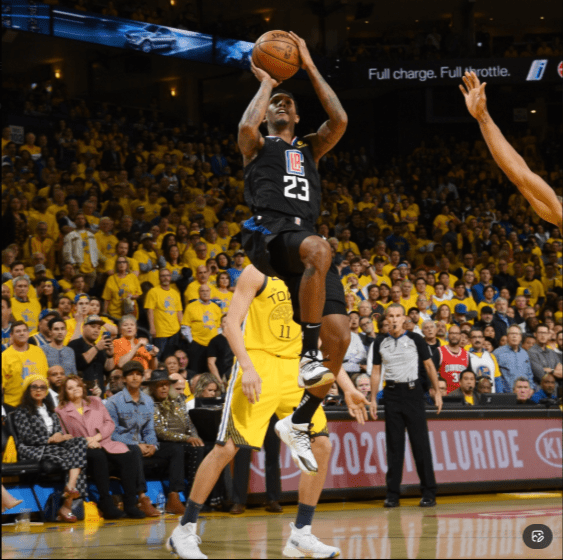
This thoughtful activism was born from his unique journey. Having lived in a predominantly Black community and successfully integrated into a multicultural one, Williams understood both the specific injustices facing Black Americans and the power of bridging divides. He couldn’t “shut up and dribble” because his life had been a curriculum in America’s complexities. His voice carried the weight of lived experience in multiple worlds.
THE LEGACY OF ADAPTATION: FROM “LOU WILL” TO ANALYST
Today, Lou Williams’ transition is complete. Retired from playing, he now works as a sharp, respected basketball analyst on FanDuel TV’s “Run It Back”. The same perceptiveness that helped him decode defenses and new cities now serves him in breaking down the game.
His career stands as a powerful testament to a rarely celebrated form of resilience: the resilience of the adaptor. In a sports culture that often glorifies the one-team legend, Williams’ legacy is that of the brilliant mercenary, the man who could thrive anywhere because he was forged in displacement.
His story refutes the old adage that you must stay true to where you’re from to be authentic. Williams became his most authentic self by leaving home. He took the toughness, loyalty, and shot-making of Memphis and fused it with the worldly awareness, social agility, and expansive confidence he earned in Atlanta. The result was a player and a man uniquely equipped for the demands of modern professional sports and life.
The kid who once looked for Memphis snow in a Georgia suburb found something far more valuable: the blueprint for turning culture shock into a superpower. He didn’t just survive the transition; he absorbed it, letting it reshape him into one of the most effective, enduring, and socially conscious players of his generation.
In the end, Lou Williams’ greatest victory wasn’t a trophy or a scoring title. It was proving that the most challenging journeys those that force you to re-examine everything you know are often the ones that prepare you best for everything to come.
Can true versatility only be born from the experience of being an outsider, and does the modern world reward those who, like Lou Williams, learn to make a home wherever they land?