This was the moment he lost control.
It happened with a kind of violent grace. Not a scream first, but a movement a sudden, decisive propulsion from the Warriors bench that seemed to draw all the sound from the arena into its wake. Steve Kerr did not argue from his seat. He did not take a step onto the court to protest.
He erupted onto it, his body crossing the boundary between coach and combatant in three long, furious strides. The technical foul whistle was immediate, a sharp, transactional shriek. He did not hear it. He was already in motion toward the officials, his face not contorted in anger, but set in a frightening, focused clarity.
The second whistle came, the ejection signal, and he turned without breaking stride, walking past his stunned assistants, past his open-mouthed players, down the tunnel and into the private dark.
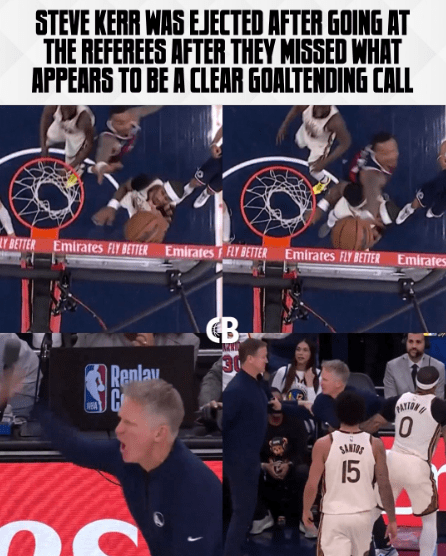
The game, with its runs and rhythms, its meticulously crafted strategies, continued behind him. But for Kerr, in that suspended silence after the collision between his will and the game’s immutable law, something else had ended.
The Catalyst: A Fracture in the Trust of Time
To understand the eruption, you must feel the weight of the preceding seconds. The Warriors, clinging to a thinning lead, were in their motion offense the beautiful, interwoven system Kerr had installed a decade prior as an article of faith in collective intelligence over individual dominance.
Stephen Curry came off a screen, the ball a temporary extension of his will. Zach Collins, the Spurs’ center, rotated, his hand meeting the ball not on its rise, but at the precise, vulnerable apex of its arc. The goaltend was obvious to the naked eye, a violation of basketball’s most fundamental vertical law. No whistle came.
Two possessions later, Curry drove again. Contact was made, a glancing friction against his shooting arm that altered his balance mid-air. He landed off-kilter, the shot falling short. Again, silence from the officials. These were not judgment calls in a gray area; they were, in the kinetic language of the game, clear sentences left unpunctuated.
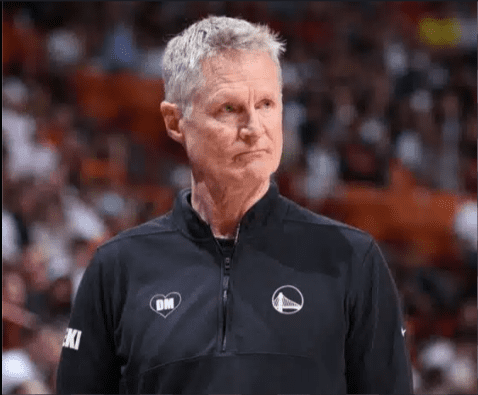
For Kerr, these moments represented more than missed calls. They were fractures in the implied contract of the contest. His entire basketball philosophy as a player under Phil Jackson, as an executive, as the architect of the Warriors’ dynasty as built on the premise that the game, at its core, was a test of skill executed within a framework of consistent rules.
The officials were not adversaries; they were the guardians of that framework. The no-calls on Curry were not just errors; they were a silent negation of the very premise Kerr had built his professional life upon. If effort and skill could be rendered moot by an unseen transgression, then what was the point of all the preparation, all the film, all the practiced trust?
The Anatomy of the Snap: Why This Moment, Why This Man?
Steve Kerr is not a ranter. His coaching eruptions are rare, surgical, and almost always directed inward at his own team’s lapses in focus or effort. The referees were typically a separate category, addressed with a pained smirk, a hands-on-hips exasperation, a quiet, searing remark to his assistants. This was different. This was total system failure.
The trigger was likely not the magnitude of the calls, but their cumulative context and their target.
First, the cumulative grind: This was the 2023-24 season, a campaign defined not by coronation but by corrosion. Draymond Green’s suspensions, Klay Thompson’s struggling search for his former self, the relentless pressure to extend a dynasty’s fading pulse.
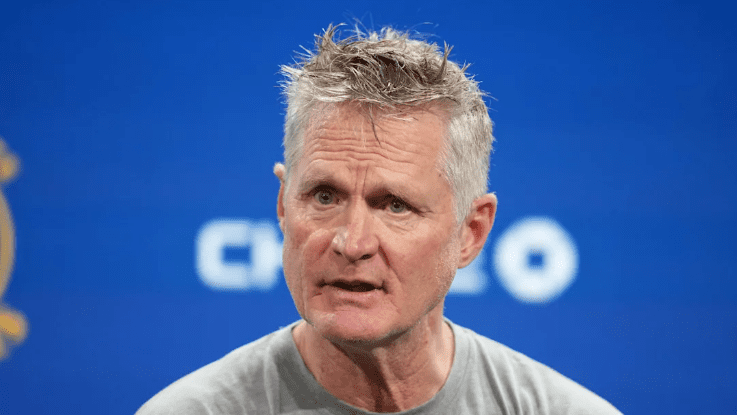
Every game was a referendum on legacy, every loss a crack in the monument. Kerr had spent months as part-coach, part-therapist, part-damage-control officer. The composure required was a daily tax on his emotional reserves.
Second, the specific target: Stephen Curry. Curry is not just Kerr’s best player; he is the living validation of Kerr’s entire basketball belief system. Kerr empowered Curry’s audacious shooting, built an offense to maximize his gravitational pull, and staked his reputation on the idea that this slight guard could redefine the sport.
To see Curry, the embodiment of skill and effort, denied the basic protection of the rules, was not an insult to a superstar. It felt, in that heated moment, like an insult to the idea that built them both. It was personal in a way that transcended the scoreboard.
His body language in the seconds before the explosion was telling. He did not jump up. He sat, frozen, for a full three seconds after the second no-call, his eyes locked on the officials as play rushed back the other way. It was the stillness of a man running a final diagnostic, confirming a catastrophic error.
The Aftermath: The Cost of Crossing the Line
The immediate aftermath of an ejection is a strangely hollow spectacle. The game, a creature of habit, absorbs the shock and moves on. An assistant assumes the clipboard. Players recalibrate. For the ejected, however, time splits. There is the public narrativethe highlight clip, the press conference explanation, the league fine (a predictable, almost ritualistic cost of doing business). And then there is the private reckoning.
For Kerr, walking off that court carried multiple, silent costs:
- The Cost of Abandonment: However justified he felt, he had voluntarily left his team. In a close fourth quarter, he chose principle over presence. This is the coach’s ultimate sin, and the guilt of it, felt in the quiet of the locker room, is a more potent punishment than any fine.
- The Cost of Revealed Vulnerability: For a leader whose superpower has been preternatural calm in the playoff hurricane, the eruption showed a crack. It showed players, opponents, and the world that the pressure could, in fact, reach him. The unflappable persona was momentarily flapped.
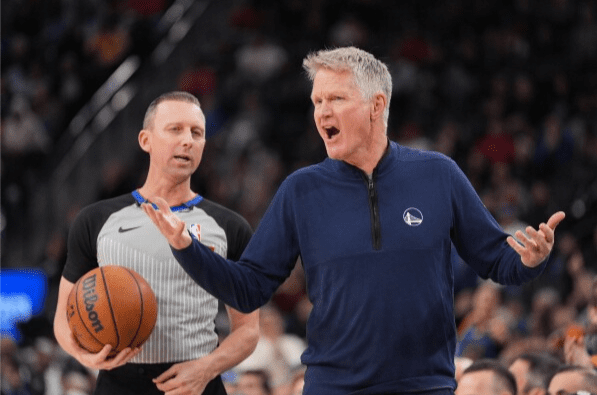
- The Cost of Legacy Distortion: In the digital age, a moment defines a man. Kerr’s legacy is five championships, an .800+ winning percentage in the Finals, and the modernization of an offensive philosophy. Yet, for a segment of the audience, he will now also be “the coach who lost it over a no-call.” The complex tapestry of a career reduced to a single, fiery thread.
Table: The Dichotomy of Steve Kerr’s Leadership Persona
| The Calm Facade (Public Persona) | The Revealed Fracture (The Ejection Moment) |
|---|---|
| Strategic timeout speeches | Wordless, kinetic eruption |
| Analytical post-game pressers | Emotion overriding analysis |
| Managing superstar egos | Primal protection of his star |
| Trust in the system | Implied contract with the system broken |
The Unresolved Tension: What Remains When the Anger Fades
Kerr would later explain the ejection with typical, clipped clarity: “I was just standing up for my guys.” It was the acceptable, team-friendly cliché. But it was incomplete.
The deeper, unresolved tension the moment exposed was not about officiating. It was about the exhausting burden of stewardship. Kerr is not just coaching a basketball team; he is the caretaker of a cultural artifact the Warriors dynasty. Every loss, every controversy, every unfair call is not just a blot on the record; it feels like a chip away at the legacy he helped build.
The ejection was the moment the weight of that stewardship exceeded his capacity for calm management. It was the point where the coach, tasked with controlling everything, admitted through action that some things like the fallibility of the system he believed in were beyond his control.
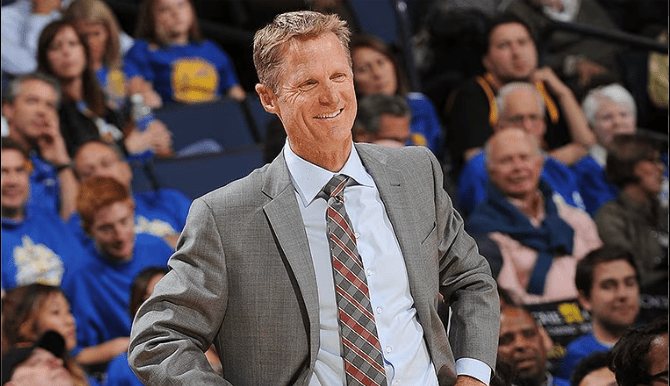
The game ended. The Warriors likely won or lost. The league office mailed the fine. The story entered the archive of NBA controversies. But for Steve Kerr, the moment in the tunnel after the walk-off lingers. It’s the silence after the second whistle.
It’s the question every leader who has ever snapped must eventually answer: Did I break my composure for a cause worthy of the cost? And having shown my team I can break, what do I now rebuild myself into?
The tension was never about the call. It was about what the call and his reaction to it revealed was already broken. Not the rules, but the fragile, human faith that they would always, somehow, be enough.