A THIRD TERM GAMBLE: HOW MAVERICKS OWNER MIRIAM ADELSON’S $250 MILLION PLEDGE IGNITES A CONSTITUTIONAL DEBATE AT THE WHITE HOUSE
The setting was the White House’s Hanukkah celebration, a gathering marked by tradition and ceremony. But on a December evening in 2025, a billionaire sports owner seized the moment to make a political proposition that cut to the heart of American democracy. As President Donald Trump addressed the crowd, he revealed an astonishing private conversation.
“She said, ‘Think about it, I’ll give you another $250 million,'” Trump recounted, nodding toward Dallas Mavericks majority owner Miriam Adelson. Standing just feet away, Adelson did not demur. She immediately confirmed the offer to the room: “I will give”.
The “it” she wanted Trump to think about was a prospect forbidden by the U.S. Constitution: a third presidential term in 2028. With that single, staggering financial pledge, Adelson—a physician, casino magnate, and one of the world’s wealthiest individuals did more than just reaffirm her status as perhaps Trump’s most powerful benefactor. She publicly launched a speculative campaign to challenge a foundational American rule and, in doing so, exposed the extraordinary intersection of wealth, sports ownership, and raw political ambition.
BUT THIS STORY ISN’T CONFINED TO THE WHITE HOUSE. IT ECHOES THROUGH THE HALLS OF THE DALLAS MAVERICKS, A FRANCHISE NOW CAUGHT IN A REMARKABLE IDEOLOGICAL DIVIDE. On one side sits Adelson, a historic GOP megadonor. On the other remains Mark Cuban, the team’s vocal minority owner and a key surrogate for Trump’s Democratic rival, Kamala Harris. Their partnership is a case study in how modern political warfare can coexist with professional sports business, proving that even a shared goal of winning championships cannot fully overshadow a clash of foundational beliefs.
WHAT DRIVES A SPORTS OWNER TO PUBLICLY OFFER A QUARTER-BILLION DOLLARS FOR A CONSTITUTIONALLY DOUBTFUL CAUSE? And how does a franchise navigate the tidal forces when its ownership box becomes a proxy for the nation’s deepest political divides? The saga of Miriam Adelson’s pledge is a story about the limits of money, the rigidity of law, and the new reality where the battle for America’s future is also fought on the hardwood.
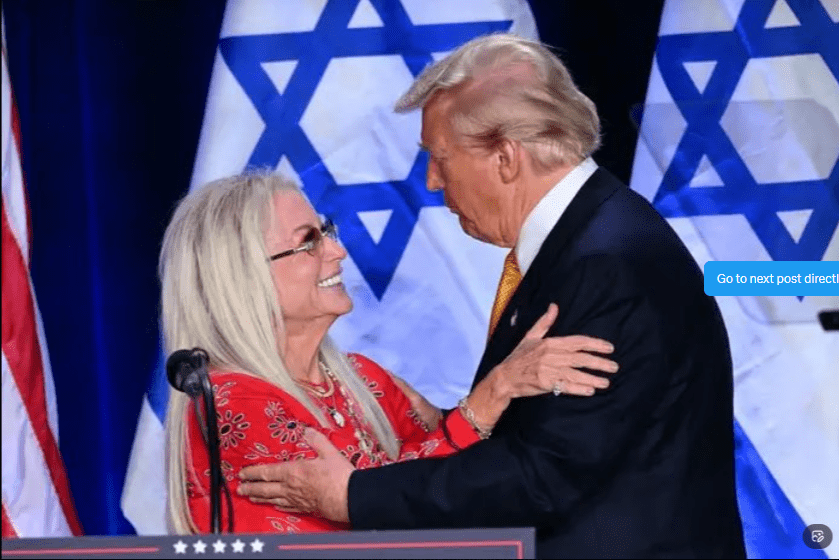
“THE PRO-ISRAEL DONOR WITH A $100 MILLION PLAN”: THE MAKING OF A POLITICAL JUGGERNAUT
To understand the weight of Adelson’s $250 million offer, one must first understand her decades-long evolution into a political force of nature. With an estimated net worth of $34.6 billion, she is not just rich; she is strategic, patient, and focused with her wealth.
Her political identity is built on two unwavering pillars: staunch support for Israel and unwavering loyalty to Donald Trump. An Israeli-American, Adelson has used her fortune to become one of the most influential voices advocating for pro-Israel policies in Washington, including support for Israeli annexation of the West Bank. This advocacy is deeply interwoven with her support for Trump, whom she has credited with unprecedented friendship toward the Jewish state. She once wrote that Trump deserved a “Book of Trump” in the Bible for his support of Israel.
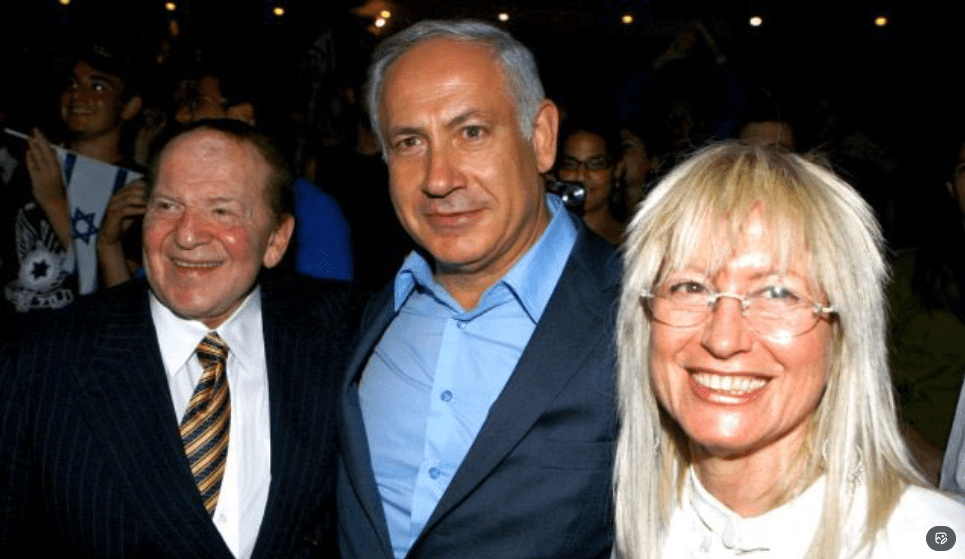
Her financial commitments match her convictions. Alongside her late husband, casino magnate Sheldon Adelson, she was the largest donor to Trump’s first presidency, funding his 2016 campaign, inauguration, legal defense, and 2020 reelection bid. In the 2024 cycle, she was the third-largest donor to Trump’s campaign, contributing $106 million. A report from late 2025 noted she had spent about $100 million backing Trump through her Preserve America PAC alone, a sum that dwarfs the payroll of the NBA team she owns.
Her offer at the Hanukkah event was not a spontaneous gesture but a capstone to this long history. It was a statement that her commitment—and her checkbook—remains open, even for the most audacious of political projects. As the New York Times headlined in a profile, she is “The Pro-Israel Donor With a $100 Million Plan to Elect Trump.” Her $250 million third-term tease suggests that plan is only expanding.

THE 22ND AMENDMENT WALL: WHY ADELSON’S MONEY FACES A CONSTITUTIONAL BRICK WALL
For all its dramatic flair, Adelson’s offer immediately collides with a formidable obstacle: the United States Constitution. The 22nd Amendment, ratified in 1951, states unequivocally: “No person shall be elected to the office of the President more than twice”.
Trump himself acknowledged this reality at the same event, admitting a third-term run would be “constitutionally impossible”. The amendment was designed as a direct safeguard against the concentration of executive power, a core principle of the American republic. To change it would require a Herculean political effort: a two-thirds vote in both the House and Senate, followed by ratification from at least 38 of the 50 states.
As of late 2025, while Republicans held slim majorities in Congress and control of 28 state legislatures, they fell far short of the supermajorities needed for such an amendment. This makes the prospect of a legal third-term election for Trump, through conventional means, a political fantasy.
Yet, the conversation at the White House hinted at legal loopholes being explored. Adelson mentioned consulting with famed attorney Alan Dershowitz, who supposedly said, “four more years. We can do it”. Speculation has centered on one theoretical scenario:
Trump running for Vice President in 2028 alongside a loyalist like current VP JD Vance, then succeeding to the presidency through resignation or other means. While the 22nd Amendment bars election to the presidency more than twice, its language on succession is less explicit, leaving a gray area for constitutional scholars and political gamblers to debate.
However, such a maneuver would almost certainly trigger an immediate and explosive legal battle destined for the Supreme Court. Adelson’s $250 million, therefore, is less a practical fund for a campaign and more a symbolic war chest for what would be an unprecedented constitutional crisis. It is a bet not just on a candidate, but on the potential to bend the very framework of American governance.
THE CUBAN COUNTERWEIGHT: A MAVERICKS OWNERSHIP AT ODDS
The political shockwaves from Adelson’s offer reverberate directly into her own business: the Dallas Mavericks. The team’s ownership structure presents a fascinating microcosm of America’s political polarization.
On one side is Adelson, the majority owner and a Trump icon. On the other is Mark Cuban, the longtime face of the franchise who retains a minority stake after selling controlling interest to Adelson in late 2023. Cuban is Adelson’s perfect political opposite. A vocal and energetic surrogate for Kamala Harris in the 2024 election, he campaigned for her in battleground states and consistently framed the choice as one between stable, policy-driven leadership and Trump’s divisive “salesmanship”.
Cuban’s disillusionment with Trump is personal and policy-driven. He initially supported Trump in 2016 but turned away, citing a pivotal moment when he asked Trump about the gravity of presidential decisions. “He wouldn’t respond,” Cuban recalled. He came to view Trump as a leader with no policy depth, all “talking points and soundbites”. “He doesn’t want to govern,” Cuban has said. “He wants to sell”.
Despite this chasm, both billionaires insist their partnership works. “We are friends and partners,” Cuban told Front Office Sports. “Just like we have been for years. Politics doesn’t get in the way”. This détente extends to the team’s superstar, Kyrie Irving, an outspoken critic of Israel’s war in Gaza, which places him at odds with his owner’s core political cause. The Mavericks have become a living experiment in compartmentalization, where colossal political disagreements are sidelined for the pursuit of a championship.
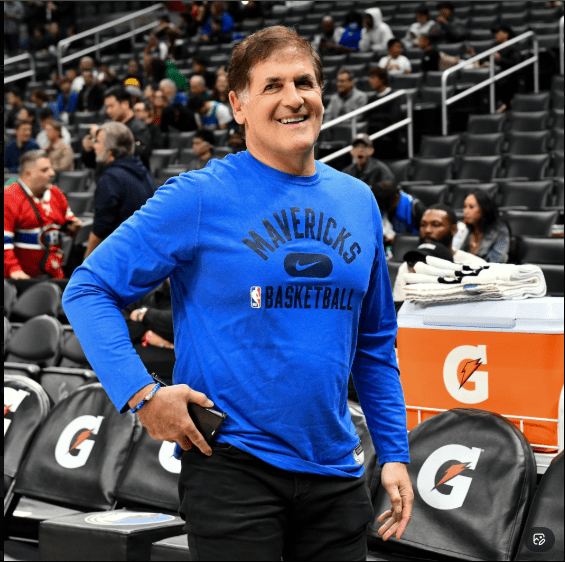
Yet, Cuban has drawn one red line. He has stated that the only circumstance that might make him reconsider his firm “hell no” stance on running for president himself would be if Trump actively tried to run for a third term. “Because then that’s just changing everything, right? And that’s a true threat,” Cuban told Semafor. Adelson’s very public flirtation with that idea may have just nudged the door to a Cuban presidential candidacy however unlikely ajar.
THE NBA’S POLITICAL LANDSCAPE: ADELSON IN A LEAGUE OF HER OWN
Miriam Adelson’s political activism places her in a unique category, but she is not alone among NBA owners in engaging in the partisan fray. The league’s boardrooms are filled with billionaires who wield financial influence in politics.
A survey of political giving reveals a spectrum of involvement:
- The Megadonor: Adelson is in a tier by herself, with her nine-figure donations to Trump-affiliated PACs.
- The Trump Supporters: Houston Rockets owner Tilman Fertitta donated $420,000 to pro-Trump PACs, while also hedging with smaller donations to pro-Harris groups. New York Knicks owner James Dolan is a longtime friend and supporter, though he made no direct 2024 campaign donations.
- The Democratic Backers: Indiana Pacers owner Herb Simon donated over $380,000 to Democratic candidates and causes. Washington Wizards owner Ted Leonsis gave to both sides but contributed $50,000 to a Harris PAC.
- The Primary Challengers: Some owners, like Minnesota Timberwolves’ Glen Taylor and Philadelphia 76ers co-owner David Blitzer, donated to Trump’s Republican primary rivals like Nikki Haley.
This political engagement by owners often exists in tension with their players, who have become increasingly vocal on social and political issues. LeBron James famously called Trump a “bum”, while Stephen Curry’s Warriors refused a White House visit after their 2017 championship. The modern NBA is a league where owners’ checkbooks and players’ megaphones often project conflicting political messages, with franchise values and brand identities caught in the middle.
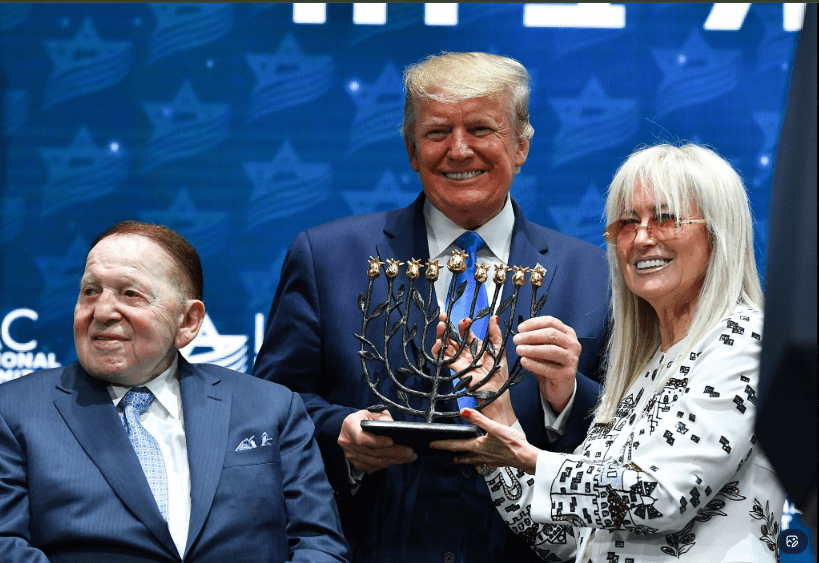
Adelson’s extreme financial commitment amplifies this tension to its zenith. She is not a passive donor but an active architect of a political project that many of her players and a significant portion of her fanbase may vehemently oppose. Her ownership tests the limits of whether sports can truly be an apolitical escape when the person signing the checks is one of the most potent political forces in the nation.
THE $250 MILLION QUESTION: SYMBOLISM OR A SERIOUS THREAT TO PRECEDENT?
So, what is the true significance of Miriam Adelson’s extraordinary offer? It operates on multiple levels, from the symbolic to the subtly strategic.
First and foremost, it is a powerful symbol of unwavering loyalty. In the transactional world of politics, the pledge reaffirms Adelson as the most reliable financial fortress in Trump’s world. It sends a message to the political ecosystem that the Adelson-Trump alliance remains the most potent fundraising force in American politics, undimmed by electoral or constitutional norms.
Second, it fuels a narrative. The very discussion of a third term, especially when blessed by a figure of Adelson’s stature, begins to normalize an idea that was once unthinkable. It feeds a base’s longing for indefinite leadership and keeps opponents off-balance, forcing them to debate hypothetical constitutional crises instead of current policies.
Practically, however, the $250 million is far more likely to be deployed in looming political battles than a quixotic third-term bid. The funds could fortify Republican efforts to hold Congress in 2026, influence the 2028 presidential primaries to ensure a pro-Trump successor, or bankroll legal armies for the endless lawsuits that define modern political warfare. The third-term talk may be the headline, but the money’s real impact will be felt in more conventional yet equally consequential political arenas.

For the Dallas Mavericks, the pledge ensures the franchise will remain in the political spotlight. Every win, loss, or roster move will be viewed through the dual lens of sports and the owner’s national political campaign. The team has become more than a basketball club; it is a flagship asset for a political movement.
Miriam Adelson’s $250 million promise is a landmark moment in the fusion of wealth, sports, and political ambition. It demonstrates that for some, the arena of influence extends far beyond the basketball court or the casino floor, reaching into the very rules that govern presidential power. The offer may ultimately be impossible to accept, but in making it, she has already reshaped the conversation and cemented her role as a central character in one of the most unusual chapters in American political history.
When the personal fortune of a sports owner can fund a direct challenge to a constitutional amendment, does the traditional separation between arena politics and national politics cease to exist?