The Viral Lie That Changed NBA History: How a 3-Second Clip of J.J. Barea Tricked the World and Buried the Greatest Defensive Masterclass You Never Saw Coming
The most enduring story from the 2011 NBA Finals lives on a loop. It is grainy, short, and perfectly misleading.
In the clip, J.J. Barea, all 5’10”, stands defiantly before LeBron James. LeBron catches, dribbles hesitantly, and passes away. The crowd roars. The image is unforgettable.
This visual became basketball folklore. The narrative wrote itself: the mighty LeBron was shutdown by a backup point guard. It was an irresistible underdog tale.
But folklore is not fact. This clip is a masterclass in selective editing. It shows the what but completely erases the how, the why, and the who else on the floor. It is the seed from which a colossal historical misunderstanding grew.
2. The Camera Frame Is a Liar: What Really Happened on Those Switches
The viral moment never shows the full court. That missing context is everything. Barea was never assigned to guard LeBron.
His confrontations occurred only on defensive switches after Miami’s screens. This created a temporary, explosive mismatch that cameras loved.
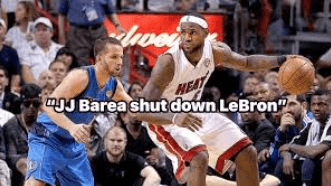
But pull the lens back. Every single time Barea switched onto LeBron, the Dallas defense was already in motion. It was a trap, not a matchup.
Tyson Chandler immediately slid into the paint as a terrifying rim protector. The nearest wing defender collapsed into the driving lane. The weak side defender prepared to intercept a pass.
LeBron wasn’t staring down Barea. He was staring at a wall of three defenders. The scheme funneled him into a low-percentage, contested jumper. He often took the bait and passed. The clip shows a pass. The scheme forced the pass.
3. The “Hybrid” Hell: Dallas’ Defense Was Not a Simple Zone
Calling it a “zone” is a dramatic oversimplification. Rick Carlisle built something far more sophisticated: a man defense with zone principles.
The primary rule was absolute. Protect the paint at all costs. All five defenders kept a foot near the lane, choking off driving space for Wade and James.
The second rule was aggression. Help came early, not late. Defenders would “stunt” at ball handlers on their first dribble, creating constant visual pressure.
The third rule was connectivity. Rotations were a synchronized ballet. When one man helped, the next instantly covered his assignment, and a third rotated to the next threat.
This system required supreme communication and trust. Jason Kidd was the field general. Tyson Chandler was the anchor. It turned five individuals into a single, intelligent organism designed to confuse and suffocate.
4. The Warning Shot: How This Same Scheme Swept Kobe Bryant
This was not a scheme invented for LeBron. Its true unveiling came two rounds earlier, against the defending champion Lakers.
Kobe Bryant, an all-time great zone breaker, was the ultimate test. The Mavericks’ defense didn’t just pass; it dominated.
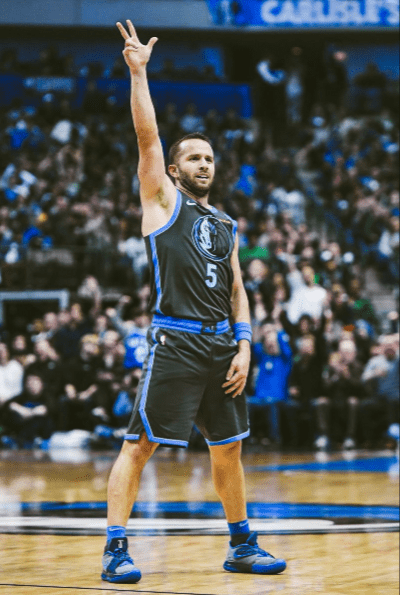
They used the same principles: packed paint, early help, swift rotations. They isolated Kobe from his offense, forcing him into difficult, late clock jumpers over multiple defenders.
Kobe shot a dismal 22% from three point range. The Lakers’ famed triangle offense disintegrated into stagnant isolation. Dallas swept the back-to-back champions 4-0.
This was the blueprint. Proving it could dismantle a championship-tested scorer like Bryant gave Dallas unwavering confidence. Miami was not facing a fluke; they were facing a proven giant-killer.
5. Exploiting the Blueprint: Why LeBron’s Game Was the Perfect Target
The Mavericks didn’t change their scheme for Miami. They applied the proven blueprint to the Heat’s specific, and exploitable, weaknesses.
Miami’s offense relied on drive and kick basketball. Dallas refused to fully collapse, instead “showing” help while staying home on shooters. This took away the easy kick out pass.
Their most daring tactic was going under screens and playing off LeBron. They dared the 26 year old version of James to beat them with jumpers he had not yet mastered.
This was a psychological and strategic gambit. It preyed upon a young superstar still refining his late-game toolkit. His post game was basic. His decision making against complex rotations could be deliberate.
The scheme amplified every hesitation. It forced him to process a defensive puzzle that moved faster than he could solve in 2011. This wasn’t a mental block; it was a strategic bottleneck.
6. The Stolen Legacy: Why This Truth Matters More Than the Myth
The Barea myth persists because it’s simple. It reduces a complex team triumph to a cartoonish one-on-one showdown. In doing so, it steals a rightful legacy.
It diminishes J.J. Barea, who was crucial as an offensive spark, not a defensive stopper. It unfairly frames LeBron’s struggle as purely personal, ignoring the strategic masterpiece he faced.
Most tragically, it erases the brilliance of Rick Carlisle’s coaching, Tyson Chandler’s defensive leadership, and the collective IQ of veterans like Kidd and Marion.
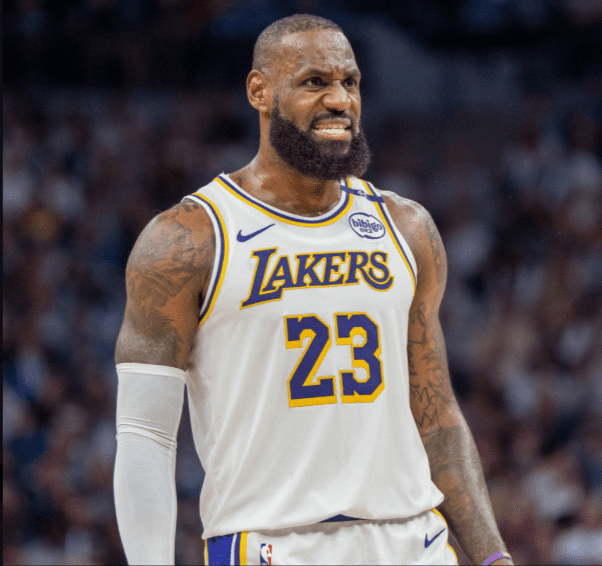
The 2011 Mavericks won because they built an intellectual fortress. They beat the defending champions and then the super team by being five minds connected as one.
The truth isn’t in a three-second clip. It’s in the silent rotations, the shouted calls, and the proof that even kings can be out thought by a perfect team. That is the real, unforgettable story.