The Divine Indifference: How Kevin Durant’s Blasphemous Dismissal of Magic and Bird Is Not Arrogance, But the Ultimate Declaration of a New Basketball Faith Where Mastery Trumps Mythology
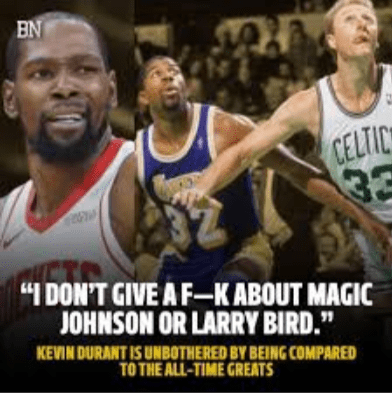
The statement lands with the force of a theological grenade, exploding in the sacred cathedral of NBA history. “I don’t give a f*k about Magic Johnson or Larry Bird, what they’ve done in comparison to me.” The speaker is Kevin Durant, the 7-foot scoring savant, a man whose entire career has been a silent argument against the very traditions he now explicitly dismisses.
The context is a conversation about legacy, about the obsessive, external ranking of players that defines modern sports discourse. Durant’s response is not a claim of superiority; it is a philosophical secession. He is not saying he is better than Magic or Bird. He is saying their achievements, their mythology, their place in the historical firmament, are irrelevant to his own internal standard of greatness.
He is declaring independence from the court of public opinion and retreating to the only court that matters to him: the one where his jump shot, his handle, and his understanding of the game are the sole metrics of his worth. This is not a hot take; it is a spiritual manifesto. It is the logical endpoint for a player who has been analyzed, criticized, and compared into a state of pure, focused alienation.
Durant isn’t disrespecting Magic and Bird; he is rejecting the entire comparative industrial complex that uses them as benchmarks. He is telling the basketball world: “You debate my place at the table. I am too busy perfecting my game to pull up a chair.” And in doing so, he reveals the terrifying, lonely truth at the heart of modern superstar existence: that the pursuit of being the “Greatest of All Time” is a hollow, distracting idol, and the only true goal is to become a god of your own domain.
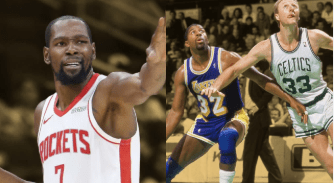
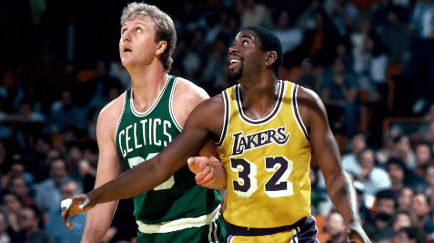
To understand the radical nature of Durant’s declaration, one must first understand the pantheon he is ostensibly dismissing. Magic Johnson and Larry Bird are not just great players; they are cultural resurrectionists. They saved the NBA from obscurity in the 1980s with a rivalry built on contrasting styles, charismatic personas, and unambiguous team-building.
Their legacies are narrative masterpieces: Magic, the joyful conductor of “Showtime”; Bird, the relentless, trash-talking hustler from French Lick. Their greatness is inseparable from the stories they authored the championships, the iconic moments, the way they lifted their teams and the league. Durant’s statement, “The standard that they set, I want to reach that. As far as longevity, relevance, impact on the game, impact on the city. Championships I want that too,” proves he understands and respects the blueprint. His “I don’t give a f—k” is directed at the comparative exercise itself, not the men.
He is sick of his life’s work being reduced to a checkbox exercise against theirs. He exists in a different universe. Magic and Bird were pre-social media giants, their narratives controlled by networks and print magazines. Durant is a post-social media atom, his every move, thought, and failure dissected in real-time by millions. The pressure to conform to an external legacy template is infinitely greater for him. His dismissal is a defense mechanism of the highest order a way to preserve his sanity and his love for the game by rejecting the noise of a debate he can never win on terms set 40 years ago. He is not comparing himself to ghosts; he is competing with the version of himself he hasn’t yet become.
1. The “Mastery” Doctrine: Durant’s Internal, Unassailable Metric
When Durant says, “I feel like I’ve mastered the game and that should be the only goal for every player,” he is outlining a self-contained theology of greatness. This “mastery” is his primary deity.
In Durant’s faith, mastery is quantifiable but not comparative. It is about the seamless integration of skill, size, and basketball IQ until the game becomes an extension of one’s own nervous system. You don’t measure it against Bird’s passing or Magic’s flair; you measure it against the platonic ideal of your own potential.
His game is the proof of this doctrine. A 7-foot player who can:
- Shoot over anyone with the efficiency of a specialist (career 50/38/88 shooting splits).
- Handle the ball like a guard, creating his own shot from anywhere.
- Defend multiple positions with his length.
- Pass with underrated vision.
He is a basketball singularity a player whose skill set is so complete, so tailored to the modern game, that comparing him to previous eras becomes an exercise in apples and oranges. Bird was a better passer and rebounder. Magic was a better pure playmaker. But neither could or needed to do what Durant does as a three-level scoring cyborg.
His mastery is context-proof. It doesn’t require a specific system or a legendary rival to shine. It is portable, reliable, and devastatingly efficient. This is why he “can relate to the Michael Jordans, the Kobes, the LeBrons.” He sees in them the same pursuit of total, self-referential dominance. Their mastery, like his, exists independently of the number of rings or the specific names they vanquished. The rings are a byproduct, not the definition.
By prioritizing mastery, Durant creates an un-loseable argument. You can dispute his leadership, his playoff failures, his decision to join the Warriors. But you cannot dispute that when he steps on the court, he possesses a command of the sport’s fundamental skills that is arguably unmatched in history for a player of his size. His legacy is the shot, not the story.
2. The Ghost of the Warriors: The Unshakeable Narrative Anchor
Durant’s quest for a self-defined legacy is perpetually haunted by one inescapable specter: his 2016 decision to join the 73–9 Golden State Warriors.
That move is the anti-narrative that forever complicates his place in the external GOAT debate. It is the original sin in the eyes of the legacy gatekeepers. As the article notes, “That move will likely follow the ‘Slim Reaper’ for the rest of his life.”
Why? Because the traditional legacy template, built by Magic and Bird, values the struggle, the rivalry, the building. Magic beat Bird. Bird beat Magic. They elevated each other. Durant, by joining the team that beat him, is seen as having opted out of the struggle. He took a shortcut to the championship altar, and in doing so, invalidated his own journey in the eyes of the old guard.
This is the central tension of Durant’s career. He possesses internal mastery of a level that dwarfs most all-time greats. But his external narrative is seen as flawed, compromised, and less-than. His “I don’t give a f—k” is, in part, a furious reaction to this permanent asterisk. He is saying, “You judge me for one decision. I judge myself on ten thousand jump shots, on a lifetime of work. My mastery is real. Your narrative is a story you tell yourselves.”
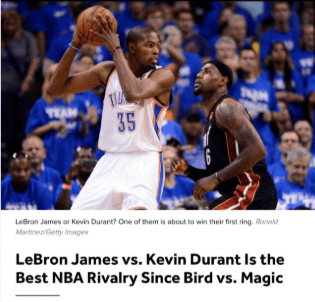
The Warriors chapters, where he won two Finals MVPs and was arguably the most dominant player on the planet, are paradoxically the greatest evidence for both sides. They prove his mastery was the final piece to create perhaps the greatest team ever. Yet, they also “will haunt Durant for the rest of his life” because they came with a pre-fabricated infrastructure of greatness. He will never escape this duality.
3. The Table He Sits At: Jordan, Kobe, LeBron
Durant’s specific call-out is revealing. He says he can “relate to the Michael Jordans, the Kobes, the LeBrons.” He places himself at that table, not Magic and Bird’s.
This is a generational and stylistic alignment. Jordan, Kobe, and LeBron are the modern era’s ultimate alpha scorers and focal points. Their teams were built around their singular, overwhelming ability to dictate terms with the ball in their hands. They are mastery manifestos in human form.
Magic and Bird, while incredible scorers, were ultimately system conductors. Magic’s genius was making others better within the “Showtime” flow. Bird’s genius was his basketball IQ and versatility within the Celtics’ machine. Their greatness was more collective and distributive.
Durant sees himself in the lineage of the soloist, not the conductor. His game is about imposing his will through scoring, not orchestrating an offense. He relates to the obsessive, singular focus of Jordan and Kobe, and the physical dominance married to skill of LeBron.
Furthermore, Jordan, Kobe, and LeBron have all endured the 24/7 scrutiny of the modern media age. They have been deified and demonized in a way Magic and Bird, for all their fame, were not. Durant shares that experience of living under the digital microscope. His “I don’t give a f—k” is a sentiment he likely believes they would privately understand, a shield against the madness.
4. The James Worthy Corroboration: Legitimacy from the Old Guard
The article’s inclusion of James Worthy’s praise is critical. Worthy, a Hall of Famer from the Magic/Kareem Lakers era, provides external validation from the very tradition Durant seems to dismiss.
Worthy says, “If I’m choosing somebody, he might be… You know, Steph shoots the three, but Durant is cold-blooded at his height.” This is not about rings or narrative; it’s about the visceral, terrifying skill Durant possesses. Worthy, who played with all-time greats, is mesmerized by the toolkit.
This endorsement bridges the gap. It suggests that true basketball savants, those who have seen greatness up close, can recognize Durant’s unique brand of it without getting bogged down in comparative mythology. Worthy isn’t comparing him to Magic; he’s acknowledging a new, terrifying form of basketball life that demands respect on its own terms.
It proves that Durant’s “mastery” argument can resonate even within the old guard. The eye test transcends era. When a legend from the 80s looks at Durant and sees a “cold-blooded” force of nature, it validates Durant’s entire premise: that his game speaks for itself, loudly enough to be heard over the din of legacy debates.
5. The Statistical Apocalypse: The Finals Numbers That Create His Case
While Durant rejects comparisons, his performance on the grandest stage provides the irrefutable data for why he feels he belongs at the top table.
His 2017 and 2018 Finals numbers are not just great; they are apocalyptic in their efficiency and dominance:
- 32.3 points, 9.3 rebounds, 6.3 assists
- 54.3% FG, 45.0% 3PT, 94.1% FT
- An 8–1 record against a LeBron James-led team at the peak of its powers.
This is the empirical evidence of mastery. Against the best competition, in the highest-stakes environment, he performed with a level of effortless, all-around brilliance that few in history have matched. He wasn’t just winning; he was redefining what a forward could do in a Finals series.
These numbers are his ticket to the table. They are the objective proof that his subjective feeling of mastery has been pressure-tested and confirmed at the highest level. You can critique the circumstances (joining the Warriors), but you cannot erase the performance. The numbers exist in a vacuum of pure basketball output, and in that vacuum, Durant is a supernova.
This is why he can be unbothered. The receipts are in the ledger. He doesn’t need to argue about Magic’s rings or Bird’s MVPs; he can point to a two-year stretch where he was, by the numbers, perhaps the most potent and efficient Finals performer ever. That is his truth.
6. The Verdict: The Liberating, Lonely Path of the Ahistorical Great
Kevin Durant’s statement is the ultimate act of basketball existentialism. In a world obsessed with ranking players against a dead past, he has chosen to define his own meaning.
He is not blaspheming against Magic and Bird; he is opting out of their religion. Their faith is one of narrative, rivalry, and team-building. His faith is one of skill, mastery, and self-actualization.
This path is both liberating and lonely. It frees him from the unbearable weight of other people’s expectations and historical baggage. It allows him to play for the love of the game itself, for the silent satisfaction of a perfect jumper, for the internal knowledge that he has squeezed every ounce of talent from his being.
But it also isolates him. It means his legacy will forever be debated in a language he has rejected. He will be measured by a standard he does not acknowledge. The crowds will chant about rings, while he is thinking about footwork.
In the end, Durant has given us the final, logical evolution of the modern superstar: a player so skilled, so analyzed, and so criticized that the only way to survive is to retreat into the fortress of one’s own game and pull up the drawbridge. “I don’t give a f—k about Magic Johnson or Larry Bird” is not an insult. It is the sound of that drawbridge rising. He isn’t on their mountain. He’s building his own, brick by perfect brick, and he’s building it alone. And from that peak, the debates of the valley simply don’t reach his ears.