“That Turned Me On”: How Jimmy Butler’s Jarringly Honest Reaction to Draymond Green and Steve Kerr’s Sideline Explosion Reveals the Hidden Eroticism of High-Stakes Conflict and the Uncomfortable Truth About What Really Fuels Champions
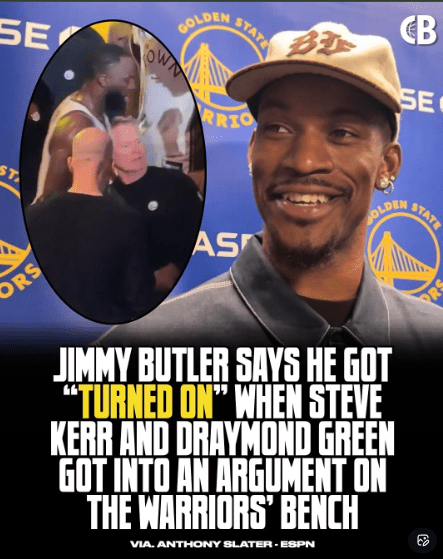
The image is seared into the collective retina of the NBA consciousness: Draymond Green, a tempest of intensity wrapped in a Warriors jersey, locked in a furious, finger pointing, spit flying verbal detonation with his Hall of Fame coach, Steve Kerr. The sidelines of the Chase Center became a pressure cooker, the air vibrating not with the squeak of sneakers but with the raw, unfiltered electricity of fraying tempers and clashing wills.
It was a moment of perceived dysfunction, a crack in the golden armor of the dynasty, a gift to the schadenfreude-fueled narratives of a waiting media. And then, from a thousand miles away, came the reaction that reframed the entire episode, that bent the narrative light into a startling new spectrum. Jimmy Butler, Miami’s ston cold assassin, the patron saint of competitive malice, was asked about the incident. He didn’t furrow his brow in concern.
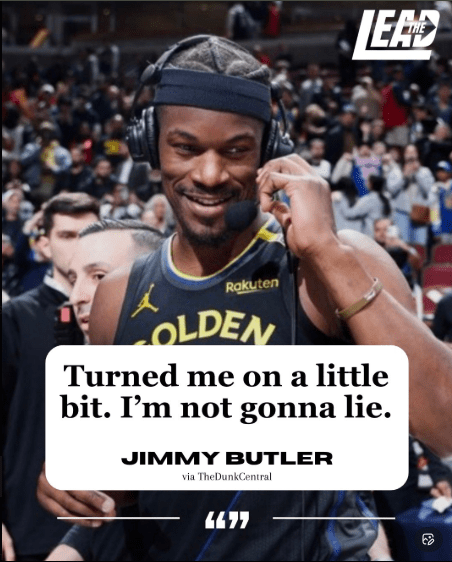
He didn’t offer platitudes about communication. He leaned into the microphone, a slow, unmistakably devious grin spreading across his face, and delivered a line that was less a comment and more a philosophical manifesto wrapped in a primal confession: “I like that. Y’all yell at each other. Turned me on a little bit. I’m not gonna lie.” The statement landed with the subtlety of a sledgehammer on a glass table. In ten seconds, Butler didn’t just comment on an NBA news cycle; he ripped open the carefully stitched fabric of sports professionalism to expose the throbbing, visceral, and yes, strangely intimate heart of what drives the greatest competitors the love of the fight, even when it’s with your own.
To dismiss Butler’s comment as merely a crude joke or a piece of shock jock theater is to profoundly misunderstand the man, the moment, and the milieu. This was not a off the cuff quip from a court jester; this was a deliberate, values driven proclamation from one of the league’s most intentional and idiosyncratic personalities. Jimmy Butler is a man who has crafted his entire identity from his “Jimmy Buckets” alter ego to his “Coffee Guy” persona around an unflinching, almost pathological commitment to authenticity and competitive fire.
He is the league’s foremost proselytizer of the “heat culture” gospel, a belief system that venerates discomfort, conflict, and earned respect over congeniality and empty praise. His reaction to Green and Kerr was the purest expression of that creed. He didn’t see a team in crisis; he saw a crucible. He didn’t witness unprofessionalism; he witnessed passion so concentrated it had to erupt.In Butler’s world, the silent resentment, the passive aggressive media leak, the polite but fractured locker room these are the signs of a dying team. The public screaming match? That’s the sound of life.
That’s the sound of people who give a damn so profoundly that the veneer of civility becomes an unacceptable barrier to truth. His use of the phrase “turned me on” is jarring precisely because it is so metaphorically accurate for a certain breed of athlete. It speaks to a state of arousal not in a literal sense, but in a competitive, adrenal, fully-engaged sense. It is the feeling of seeing your own deepest drives reflected on a national stage. It is the recognition of a kindred spirit in the chaos.
This incident, and Butler’s radioactive response, forces a deep, uncomfortable, and necessary re examination of the Draymond Green and Steve Kerr dynamic itself. For a decade, this relationship has been the unstable core of the Warriors’ beautiful machine. It is the alliance between the untamable force and the enlightened master, between chaos and order. Kerr, the philosophical Zen disciple of Phil Jackson and Gregg Popovich, believes in flow, in joy, in the collective spirit.
Green, the fiery, intellectual, and emotionally volatile engine, is all about edge, confrontation, and truth telling so brutal it can leave scars. Their arguments are not a sign of a broken relationship; they are the periodic maintenance a relationship this intense requires. It is a pressure release valve on a system that operates at unsustainable temperatures.
Their subsequent reconciliation the quick, professional move to the next play, the post game comments emphasizing mutual respect and shared history isn’t a cover up. It is the proof of concept. The fight was real. The resolution was real. The underlying bond, forged in four championship fires, was real enough to withstand it. This is not a model for every coach and player; it would be a disaster for 29 other franchises. But for this coach and this player, within this culture of earned trust and demonstrated success, it is their language. Butler looked at that and saw fluency. He saw a dialogue he understands perfectly.
Butler’s own history is a roadmap to understanding this perspective. Recall his infamous Minnesota Timberwolves practice, where he led a squad of third stringers to victory over the starters, screaming “They ain’t shit!” about Karl Anthony Towns and Andrew Wiggins to a gathered media. That was not a breakdown; it was a brutal, theatrical intervention.
It was conflict as a diagnostic tool, as a way to expose a softness he found unacceptable. His time in Philadelphia, while less explosive, was marked by a clear frustration with a talent-rich team he perceived as lacking the necessary killer instinct. It is only in Miami, under Pat Riley and Erik Spoelstra, in a culture that not only tolerates but cultivates a certain kind of beautiful discomfort, that Butler has found his spiritual home. Heat Culture doesn’t shy away from confrontation; it institutionalizes it.
Practices are wars. Standards are non negotiable. Respect is not given; it is extracted through demonstrated toughness. When Butler saw Green and Kerr going at it, he saw a flicker of Miami in San Francisco. He saw people who would rather risk an ugly moment in pursuit of a higher standard than settle for a peaceful mediocrity.
The broader NBA landscape often pretends to value this kind of raw intensity while secretly sanitizing it. The league markets “rivalries” that are often just polite competitions between friends. It promotes players as brands, their edges sanded down for mass consumption. What Butler’s comment does is tear away that curtain. It asserts that at the highest level, where championships are won in the mental trenches as much as on the physical court, a certain kind of madness is not just acceptable but necessary.
It challenges the modern obsession with “chemistry,” often misdefined as constant harmony. True championship chemistry, as the Warriors and Heat demonstrate, is not the absence of conflict. It is the presence of a trust so deep that conflict can be engaged without fear of permanent fracture. It is the knowledge that after the yelling stops, you are still going to war together on the next possession.
Psychologically, Butler’s reaction taps into something profound about high-performance environments. The adrenaline, the cortisol, the hyper focused state of competition these are potent, addictive chemicals. For athletes wired to seek that peak state, the lines between different forms of intense arousal can blur. The “fight” in all its forms against an opponent, against a standard, even against an ally in pursuit of a common goal triggers the same physiological cascade.

To say a competitive confrontation is “a turn on” is to acknowledge, in provocatively visceral terms, the addictive thrill of existing at that razor’s edge. It is a rejection of the sterile, corporate, emotionless ideal of sport. It is a reclaiming of the game’s human heart, in all its messy, passionate, gloriously unpredictable glory.
The fallout from this moment will be multifaceted. For the Warriors, it adds another layer to their already complex legend. It proves their culture is strong enough to contain multitudes, even the multitudes of a Draymond Green explosion. For the league’s observers, it provides a litmus test. Those who are scandalized or amused by Butler’s comment likely view sports through one lens as entertainment, as a business, as a skill exhibition.
se who nod in recognition, even if uneasily, understand the other lens sports as a primal arena for testing character, where the most valuable things are often forged in friction. And for Jimmy Butler, it is yet another brick in the monument he is building to his own uncompromising ideology.