The Primal, Unfiltered Moment That Explains Everything: How Josh Hart’s Viral “4K” Celebration With Jalen Brunson Captures the Grit, Glue, and Guts of the Modern NBA Champion and Exposes the Soul of a Team Built on Brotherhood, Not Just Basketball
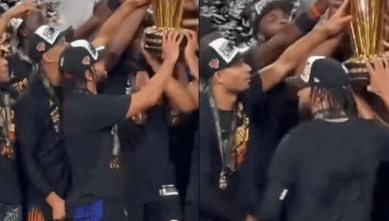
The clip is nine seconds long. It is shot in stark, unforgiving high definition the “4K” that Josh Hart would later lament captured it all. The scene is the chaotic, champagne-soaked podium after the New York Knicks secured the NBA Cup. Karl Anthony Towns hoists the trophy, a silver obelisk glinting under the Las Vegas lights. To his left, Jalen Brunson, the tournament MVP, beams, his arms raised in triumph. And then, in the periphery of the frame, the narrative shifts from ceremony to instinct. Josh Hart, Brunson’s longtime teammate and college brother from their Villanova days, moves with the casual, mischievous certainty of a man in his own living room. His left hand darts out. A single finger makes deliberate, intrusive contact with an area of Brunson’s anatomy that exists far outside the bounds of any standard celebratory pat. Brunson’s reaction is instantaneous, electric: a convulsive jump, a whipped-around head, a face caught in the hilarious limbo between shock, betrayal, and recognition.
Then, the moment passes. The camera cuts. The world, armed with this digital fossil, erupts. Hart’s social media admission“Damn. In 4k… IT WAS AI”is a masterclass in modern damage control, a joke that acknowledges the crime while refusing to apologize for the context. To view this moment as merely a crude prank or an “inappropriate gesture” is to miss its profound, wordless significance. This was not an act of harassment; it was an act of tribal language. In that unguarded, ridiculous, borderline-gross second, Josh Hart and Jalen Brunson communicated the central, unspoken truth of the 2025 New York Knicks: their bond is not professional; it is primal. Their trust is not contractual; it is complete. And their path to a championship whether the in-season Cup or the looming NBA Finals runs not through flawless basketball, but through the willingness to be this raw, this real, and this unapologetically weird with each other in the most public arena imaginable.
This moment is the direct, logical descendant of the “finger-sniffing” incident from months prior. If that was a private ritual of self-verification Hart confirming the scent of his own labor this is the public performance of shared intimacy. It is the difference between a soldier checking his own gear and that same soldier playfully tackling his brother-in-arms in the mud after a battle. Both acts are rooted in the same soil of extreme, earned familiarity. The “4K” clip is the ultimate rebuttal to the sterile, transactional model of team-building. It is anti-analytics. You cannot quantify this. You cannot diagram it in a front-office presentation. Yet, its value is incalculable. It demonstrates a level of comfort and vulnerability that translates directly to the court: the willingness to make the extra pass to a covered teammate, the instinct to help on defense without a second thought, the capacity to withstand a playoff scoring drought without fracturing.
This is the glue that holds together a roster of disparate talents. It is the reason a team can survive the pressure of a single-elimination tournament. Mike Brown spoke of the pressure breeding confidence in the “organization.” But Hart and Brunson, in their absurd, R-rated pantomime, showed where that confidence truly lives: in the unbreakable, often juvenile, bond between the men who actually have to execute. The internet saw a meme. The Knicks saw a receipt. It was proof that their culture, forged in the sweaty crucible of practices, flights, and film sessions, had produced a connection so strong it could withstand and even weaponize the global glare of a championship celebration. This wasn’t a lapse in judgment. It was a declaration of identity.
The Language of the Tribe: Decoding the “Inappropriate” Gesture
To an outsider, Josh Hart’s action is simple vulgarity. Within the specific, hyper-masculine, and intensely pressurized ecosystem of a professional sports team, it is a complex form of communication.
This gesture exists in the ancient lexicon of male bonding rituals. It is a cousin to the wedgie, the towel snap, the overly aggressive butt-slap. Its purpose is not sexual; it is social. It is a test and affirmation of belonging.
By crossing a profound boundary in a non-threatening, playful context, Hart is performing a paradoxical act. He is simultaneously asserting extreme closeness (“I can do this to you”) and offering extreme trust (“I know you will not truly retaliate or reject me for this”).
Brunson’s reaction—shock, but not anger; flight, but not fight is the perfect, accepted response. It completes the ritual. He plays the victim, Hart the instigator, and the shared history between them absorbs the shock, transforming potential offense into reinforced connection.
This is a language spoken only by those who have shared profound experiences. Their history two national championships at Villanova, countless battles in the NBA, the daily grind of practice has built a reservoir of goodwill so deep that a single transgressive act only proves its depth.
In a environment where words often fail where pressure is ineffable and stress is constant these physical, primal jokes become a pressure valve. They reintroduce absurdity and levity into a situation defined by extreme consequence.

The fact it happened on the championship podium, in front of the world, amplifies its meaning. It says, “Even here, at the pinnacle of our professional achievement, our private bond is more real to us than this public ceremony.” It is a moment of authentic humanity breaking through the polished veneer of sports spectacle.
The Villanova Continuum: How College Brotherhood Built a Professional Fortress
The “4K” moment is not an isolated incident. It is the latest flowering of a relationship planted nearly a decade ago on the campus of Villanova University.
Hart and Brunson did not just play together; they won together, cutting down nets in 2016 and 2018. They were forged in the fire of Jay Wright’s “attitude” culture, which prioritized selflessness, toughness, and collective responsibility over individual stardom.
Off the court, it allows for a level of brutal honesty that would fracture a merely professional relationship. They can critique each other’s play, challenge each other’s mindset, and yes, engage in deeply immature pranks, because the foundation is not a contract, but a brotherhood.
This Villanova pipeline which also includes Donte DiVincenzo has given the Knicks a ready-made culture core. They imported a championship mentality and a pre-existing social fabric. Hart’s prank on Brunson is the most visible symptom of this imported chemistry.
It proves their relationship transcends their workplace. They are not coworkers who get along; they are friends who happen to be coworkers. And in the NBA, where teams are temporary by design, that kind of pre-existing, organic bond is a competitive weapon of immense value.

The Celebration as Microcosm: Why This Moment Validates the NBA Cup
Detractors like Charles Barkley may dismiss the NBA Cup as a “cash grab” or a “participation trophy,” but the raw, unfiltered emotion of the Knicks’ celebration argues otherwise.
The intensity of Hart and Brunson’s interaction the sheer, dumb joy of it is not something that can be faked. It is the physiological release of genuine accomplishment. You do not risk a friendship with a prank that stupid over something you do not care about.
Mike Brown identified the key pressure point: the tournament becomes single-elimination. That format replicates, and in some ways intensifies, the win-or-go-home stakes of the NBA playoffs. It creates a shared experience of survival.
Winning it, therefore, is not empty. It is a shared trauma overcome, a collective obstacle conquered. The celebration is the release of that built-up tension. The goofy, borderline-inappropriate behavior is a sign that the pressure was real, and now it is gone.
For a Knicks team with “bigger goals,” as Brunson stated, this trophy serves a crucial purpose. It is a dress rehearsal for the ultimate celebration. It allows a team to practice winning something together, to feel the rush of a confetti shower, to navigate the heightened emotions as a unit.
The fact that their celebration so quickly devolved into childish horseplay is the ultimate proof of its authenticity. They didn’t stand around politely. They didn’t give sterile, corporate interviews. They reacted like a family at a wedding with love, chaos, and a complete lack of decorum.

The NBA Cup’s value is not in the silver trophy, but in the shared memory it creates. And for the Knicks, that memory now permanently includes a finger, a jump, and a viral clip that will forever symbolize how much they truly enjoyed winning it, together.
The “AI” Defense: Navigating Humor in the Digital Court of Public Opinion
Josh Hart’s two-part tweet reaction“Damn. In 4k… IT WAS AI” is a minute-long masterclass in modern crisis PR for a non-crisis.
The first part, “Damn. In 4k,” is a full, immediate surrender. It is an admission of guilt delivered with a wry, self-aware charm. It acknowledges the evidence is incontrovertible and that he has been caught. This disarms critics by agreeing with them.

The second part, “IT WAS AI,” is the pivot. It is the deployment of the era’s most convenient cultural scapegoat. By invoking artificial intelligence, Hart does three things: he makes a meta-joke about our distrust of digital evidence, he absolves himself through absurdity, and he frames the entire incident as a piece of comedy to be debated, not a transgression to be condemned.
It demonstrates Hart’s sophisticated understanding of the social media lifecycle. He knows the clip will spread, so he seeds its spread with his own humorous commentary, ensuring his version of events travels alongside it.
Most importantly, it protects the sanctity of the moment with Brunson. By making it a public joke, he prevents outsiders from painting it as something dark or problematic. It says, “This is our private joke, and now it’s your public meme. We’re all in on it.”
This is how modern athletes manage their personas. They cannot prevent the world from seeing their unguarded moments, but they can aggressively frame how those moments are perceived. Hart framed this one as hilarious, and because of his and Brunson’s obvious rapport, the world largely agreed.
The Contagion of Chemistry: How One Moment Validates an Entire Culture
A single, silly moment can serve as powerful validation for an organization’s entire philosophical approach. The “4K” clip is a commercial for the Knicks’ team-building strategy.
For Coach Mike Brown and the front office, this is tangible proof of concept. Their bet on character, on prior relationships, on “Villanova grit,” has produced a team whose connection is visibly, undeniably real. You cannot coach this. You can only foster an environment where it can grow.
For the other players on the roster, especially newer additions or younger stars like Karl-Anthony Towns, this moment is a demonstration of the team’s social contract. It shows that this is a locker room where you can let your guard down, where humor is a currency, and where bonds are stronger than media scrutiny.
This kind of chemistry has a direct performance correlation. Teams that genuinely like each other fight harder for each other. They communicate more honestly on defense. They are more resilient in the face of adversity because their commitment is to the person next to them, not just to the franchise name on the chest.
The clip also becomes a recruiting tool. For veterans looking to win or players tired of sterile environments, seeing this level of authentic camaraderie is attractive. It suggests a workplace that is human, not just corporate

.
Ultimately, it gives the team a unifying inside joke of epic proportions. “Remember when Hart got me in 4K?” will be a line that echoes in that locker room for years. It becomes part of their folklore, a silly but sacred touchstone that reminds them of who they were when they won their first trophy together.
The Line in the Sand: Why This Isn’t a Problem, But a Blueprint
In a hypersensitive era, some will inevitably label the moment “problematic.” To do so is to misunderstand its context entirely and to apply the rules of a office workplace to the unique, physically intimate, and emotionally volatile world of elite team sports.
The crucial distinction is consent and context. The action occurred within a decades-long relationship of mutual respect and affection, at a moment of peak emotional release. It was not an act of power or degradation; it was an act of familiarity so deep it appears alien to outsiders.
This moment actually draws a clear line. It shows that true team harmony allows for transgression without malice. The ability to navigate these immature, boundary-pushing interactions without creating lasting offense is a sign of health, not sickness.
For the Knicks, it is a blueprint. It proves their identity is not just about defensive ratings and offensive efficiency. It is about building a brotherhood so resilient it can survive, and even thrive, under the microscope of viral fame.