From Digital Shadows to Courtroom Orders: The Chilling Five-Year Legal Battle to Shield Natalia Bryant From a Stalker’s Dangerous Delusion and the Judicial Hammer That Finally Protected an Entire Family
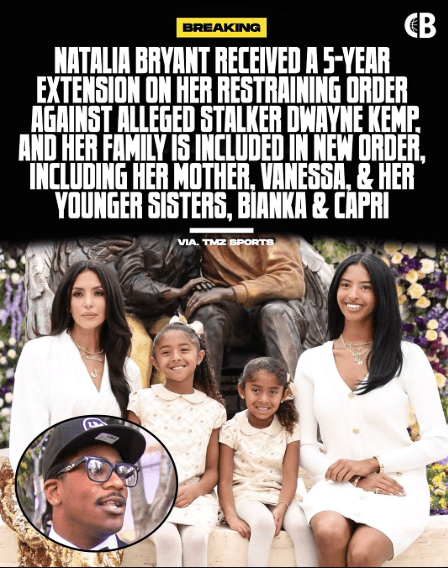
The image is not a paparazzi snapshot or a red-carpet glow. It is a document. A Los Angeles Superior Court order, stamped and decisive, its legalese forming a digital fortress. The names listed are not celebrity endorsements but protected persons: Natalia Bryant, Vanessa Bryant, Bianka Bryant, Capri Bryant. The duration is not for a film contract but for survival: five years. The man named on the other side, Dwayne Kemp, exists in the public record only through mugshots, social media screenshots, and the terrifyingly banal language of harassment. This is not a story of fame but of fear. It is the culmination of a half-decade shadow that began with a direct message to a 17-year-old girl and escalated into a courtroom where a judge, presented with evidence of guns, delusion, and a bouquet of flowers, drew a legal line around an entire family.
The extension of Natalia Bryant’s restraining order is not a routine legal procedure. It is a forensic map of modern stalking, a case study in how fixation metastasizes, and a stark revelation of the unique vulnerabilities inherited by the children of legends. When the gavel fell, it did more than prohibit one man’s contact. It ratified a terrible truth: that the legacy of Kobe Bryant, a global icon of strength and achievement, includes a target on the backs of his daughters, placed there by strangers lost in their own dangerous fantasies.

The narrative that secured this order is written in a chilling timeline of escalation. It begins in the digital ether of social media, a space where fans feel an intimate, illusory connection. It then breaches the physical world, appearing at a high school, a university campus, a family event. Each step is a test of a boundary that should not need to be stated. The legal response tracks this escalation, from a standard civil harassment order to a fortified, half-decade family-wide shield. The key piece of evidence in the latest hearing was not a violent threat in a message, but an act of grotesque, calculated normalcy:
a bouquet of flowers. This gesture, intended for delivery from a delusional man to a young woman through her grieving mother, was the final, convincing proof of a mind that does not or will not comprehend the word “no.” It demonstrated a strategy of circumvention, a belief that persistence could wear down legal and personal barriers. The court’s decision to include Vanessa, Bianka, and Capri is the system’s logical, necessary response. It acknowledges that stalking is not a laser-focused crime, but a radiation that seeks any point of entry. It understands that protection must be systemic. This ruling is a landmark of private pain becoming public precedent, a detailed blueprint of how a family, despite unimaginable loss and under the glare of the spotlight, was forced to build a wall of paperwork to keep a nightmare at bay.
The Anatomy of a Fixation: From DM to Direct Confrontation
Stalking is a crime of accretion. Its power lies in the cumulative weight of a thousand small violations, each one testable, each one deniable on its own. The case against Dwayne Kemp is a textbook example.
The timeline is critical. According to court documents, the unwanted contact began in December 2020. Natalia Bryant was 17 years old. Dwayne Kemp was 32. The medium was Instagram Direct Messages.
This was not a single message. It was a barrage. Dozens, if not hundreds, of messages poured in from multiple accounts, a digital siege that transformed a platform for connection into a source of dread.
The content of these messages established the delusional framework. Kemp constructed a one-sided romantic narrative. He spoke of a future together, of a relationship that existed only in his mind.
One message, detailed in legal filings, crossed a profound line. He expressed a desire to have a “Kobe-like child” with Natalia. This is not just a romantic fantasy; it is a direct, unsettling commodification of her most public trauma and her genetic legacy.
The fixation then achieved its first physical breach. Kemp began showing up at places she was known to be. He appeared at her high school. Later, after she enrolled at the University of Southern California, he located her sorority and her classes.

This transition from digital to physical is the most dangerous escalation in stalking behavior. It proves the fantasy is not confined to a screen. It has legs. It can travel. It can wait.
Each appearance was a message in itself: I know where you are. I can get to you. Your world is not private. The geography of her life places of learning, friendship, and normalcy was being colonized by his obsession.
This pattern, meticulously documented by Natalia and her security team, formed the undeniable probable cause for the first restraining order in 2022. It painted a picture of a fixation that was persistent, personal, and progressing.
The Legal Shield: Why the First Order Was Just a First Step
In November 2022, a 19-year-old Natalia Bryant walked into a Los Angeles courtroom not as Kobe Bryant’s daughter, but as a petitioner seeking safety. The court granted a Civil Harassment Restraining Order.
This initial order was a standard but powerful tool. It legally commanded Dwayne Kemp to stay at least 200 yards away from Natalia, her home, her car, and her workplace.
It also prohibited any form of contact: no messages, no calls, no third-party communication. It was a clear, state-enforced “NO” drawn in legal ink.
Critically, given Kemp’s documented interest in firearms, the initial order likely contained a firearms relinquishment clause. As a condition of the order, he would have been required to surrender any guns in his possession to law enforcement.
This is a common provision in restraining orders where a credible threat of violence is presented. The combination of a delusional fixation and access to weapons creates a risk profile that courts take extremely seriously.
For a time, the order seemed to work. The direct harassment may have ceased. But restraining orders are not cures; they are barriers. They do not dismantle a fixation; they merely block its most direct paths.
The psychology of a determined stalker often involves searching for weaknesses in the barrier, for gaps in the legal fence. The order protected Natalia, but it said nothing about her family.

It created a perimeter around one person, leaving the rest of her loved ones in a gray zone. This legal limitation set the stage for the next, inevitable act of escalation.
The initial order was a necessary pause button, a chance for peace. But it was built on the hope that a legal dictate could erase a deep-seated delusion. The events of August 2025 would prove that hope was fragile.
The Bouquet and the Breach: A Violation Disguised as a Gesture
On August 24, 2025, the legal barrier was tested. Dwayne Kemp attended an event “organized by Ms. Bryant and her employer.” His stated purpose was to make contact.
He did not arrive empty-handed. He brought flowers. This detail is psychologically paramount. In his mind, this was not an act of aggression, but of romance. It was a gift.
This is the sinister duality of the stalker’s mindset. Actions that are, in context, threats and violations are internally reframed as grand, romantic gestures. The bouquet was a symbol of his ongoing narrative.
When he could not locate Natalia in the crowd, he did not leave. He adapted. He attempted to deliver the flowers to Vanessa Bryant, Natalia’s mother, with the explicit intention that she pass them to her daughter.
This maneuver is a classic tactic known as “triangulation.” It is an attempt to use a third party especially a close family member as a conduit to bypass direct prohibitions. It brings the harassment into the family sphere.
It forced Vanessa, already carrying the unimaginable weight of loss, into the center of her daughter’s nightmare. It was a second-hand violation, making her an unwilling participant in Kemp’s delusion.
When confronted by security, Kemp’s defense was telling. He “admitted his conduct would violate the order,” but claimed he believed it had expired. This shows a conscious awareness of the rules, followed by a willful miscalculation.
It suggests a mind waiting for the clock to run out, monitoring the calendar for the moment the protection lapses so the pursuit can resume. The flowers were not just a symbol; they were a probe, testing the strength and alertness of the defenses.
This single act provided the court with irrefutable evidence of “continued fixation and complete disregard.” It proved the order had not stopped his intent; it had merely temporarily obstructed his method.
The Judicial Escalation: Why Five Years and Why the Whole Family?
The court’s ruling in late 2025 was not a simple renewal. It was a strategic escalation based on the evidence of adaptation and persistent threat. The judge made two critical enhancements.
First, the duration was extended to five years. In California, while permanent orders exist, a five-year term is a substantial commitment. It signals the court’s assessment that this is not a fleeting obsession but a long-term risk.
It removes the stalker’s short-term hope of the order expiring. It forces a half-decade of mandatory distance, during which the petitioner’s life can hopefully move forward without the looming deadline of a legal safeguard ending.
Second, and most significantly, the order was expanded to include Vanessa Bryant, Bianka Bryant, and Capri Bryant. This transforms it from an individual shield into a family-wide protective dome.
This expansion is a direct legal response to Kemp’s triangulation attempt. The court recognized that targeting the mother was a functional extension of targeting the daughter. Protecting one required protecting all.
By including the younger sisters, the court acknowledged the contagious nature of the threat. A stalker fixated on one family member, especially where a delusional narrative exists, can easily shift focus or use other members as leverage

.
Legally, this “family clause” is powerful. Any contact with Vanessa, Bianka, or Capri a message, an approach, a delivery—now constitutes a violation of the order against Natalia. It closes the loophole Kemp attempted to use.
It sends an unambiguous message to Kemp: This family is a unit, and that unit is legally fortified. There is no back door. There is no softer target. The perimeter has been massively enlarged and reinforced.
This ruling reflects a modern understanding of stalking as a crime against a person’s ecosystem, not just their physical body. It aims to provide holistic safety.
The Unseen Weight: Celebrity, Legacy, and the Burden of Safety
This case cannot be divorced from the context of the Bryant name. The celebrity of the family is the catalyst for the fixation, but it also uniquely complicates the pursuit of safety.
Kobe Bryant’s global icon status created a vast universe of fans. Within that universe, a tiny, pathological minority develops parasocial relationships so intense they cross into delusion.
To them, Natalia is not a stranger; she is a character in the story of Kobe they have built in their minds. Her father’s fame makes her feel accessible, known, and part of their own narrative.
Kemp’s reference to a “Kobe-like child” is the horrifying proof of this. It ties his romantic fantasy directly to her father’s public persona and athletic legacy. He is not just pursuing Natalia; he is pursuing a connection to Kobe himself.
This creates a specific, almost archetypal vulnerability for children of the ultra-famous. They are not stalked for who they are as individuals, but for whom they represent as symbols.
Furthermore, the family’s high profile makes traditional evasion tactics nearly impossible. Their schools, neighborhoods, and routines are public knowledge. They live in a fishbowl of vulnerability.
Every public appearance, every social media post by a friend, every tagged location is a potential data point for a determined stalker. Ordinary life is a constant security briefing.

The financial resources to pursue extensive legal action and employ private security are a privilege, but they are a grim necessity. This case shows that even with those resources, the legal process is grueling, repetitive, and deeply invasive.
The burden on Natalia, and now Vanessa, is twofold: to grieve a profound loss in the public eye, while simultaneously conducting a clandestine, years-long legal defense against a stranger’s dangerous fantasy. It is a relentless, hidden cost of fame.
A Precedent of Persistent Protection: What This Ruling Really Means
The five-year, family-wide restraining order is more than a verdict in a single case. It is a legal blueprint for addressing persistent, adaptive stalking, especially where indicators of potential violence exist.
It establishes a clear precedent: when a stalker uses family members to circumvent an order, the law can and will expand to seal that breach. The protection is dynamic, growing to match the threat’s evolution.
For the Bryant family, it provides a measure of durable peace. Five years is a significant portion of a young adult’s life time for Natalia to complete her education, launch her career, and build a life on her own terms, within a secured perimeter.
It allows Bianka and Capri to grow up with an added layer of legal protection, insulating their childhood from a shadow that was not meant for them. It grants Vanessa the authority to be a mother, not a security checkpoint.
For Dwayne Kemp, it is a rigid, long-term structure. It is a five-year command to dismantle his fantasy. Every day for 1,825 days, the order is a legal fact opposing his delusion. It is a forced reality check.
For the public and legal observers, this case is a masterclass in documentation. The Bryant legal team’s success hinged on a meticulous, timestamped record of every message, every sighting, every violation. It highlights the critical importance of evidence in breaking the “he-said-she-said” dynamic often exploited in harassment cases

.
Ultimately, the ruling affirms a fundamental principle: safety is not a privilege of privacy, but a right. Even for those whose lives are lived in the spotlight, the law can draw a dark, quiet circle around them and declare that within it, they are allowed to simply exist. The extended order is not a guarantee of safety, but it is the strongest possible legal declaration that the Bryants’ right to a peaceful life outweighs one man’s dangerous right to fantasize about it.