THE POST THAT WAS SUPPOSED TO BE ABOUT LOVE
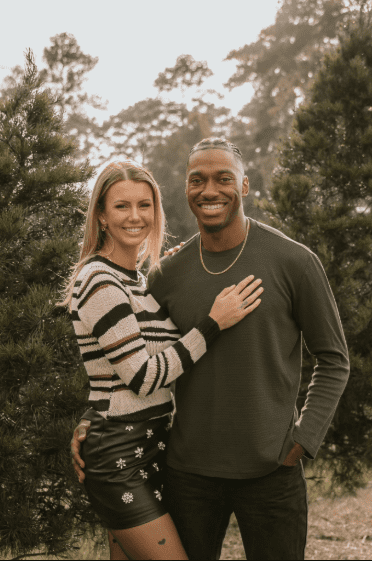
It was a simple post. A photo of a smiling family. Robert Griffin III, the former NFL Rookie of the Year turned charismatic analyst, his wife Grete, and their children, beaming in what looked like golden hour sunlight. The caption wasn’t long. It wasn’t aggressive. It was a soft, heartfelt declaration that should have been met with a cascade of heart emojis and “beautiful family” comments.
He wrote: “Never let skin color determine your love or how you treat people. I didn’t fall in love with Grete because of her skin color. I fell in love with her heart. An incredible wife, unbelievable mom and beautiful soul. Love recognizes what’s inside. Thankful to know what real love is.”
For a moment, that’s what happened. The love flooded in. But then, like a slow-moving storm cloud, the other comments arrived. Not just disagreements, but a visceral, often anonymous, backlash that turned a family photo into a battlefield.
The replies fractured into a dozen different arguments: “Why even bring up skin color if it doesn’t matter?” “He’s just virtue signaling.” “They’re a beautiful couple, ignore the haters!” “Black men need to support Black women.” “This is 2026, who still cares about this?” “He only said it because he gets hate.
The reaction proved one thing: a Black man declaring his love for a white woman in public is never just a personal statement. It is a political act, a cultural flashpoint, and a story that belongs to everyone but the couple themselves. This is the story of that post, and why a message of pure love can feel like a declaration of war in a nation that still hasn’t figured out how to talk about either.
“WHY EVEN SAY IT?” THE BURDEN OF EXPLANATION
The most common critique, often posed as a confused or cynical question, was: “If skin color doesn’t matter, why did you have to mention it?” This question, asked in bad faith by some and genuine curiosity by others, lies at the heart of the entire conflict.
It assumes a world where race is invisible, where mentioning it is what creates the problem. For RG3, and for countless people in interracial relationships, that world does not exist. The question ignores the lived reality.
RG3 didn’t post into a vacuum. He posted into a digital world where his marriage has been a topic of discussion, critique, and outright bigotry since it began. He didn’t wake up and randomly decide to talk about skin color. He was almost certainly responding to something.
A dm. A comment on an old photo. A troll in a mentions feed. The cumulative weight of a thousand micro-aggressions and not-so-micro aggressions. The post was not an unsolicited lecture; it was a reply to a conversation the public doesn’t see, fired back into the public square.

The act of stating it is a reclamation. It’s saying, “You are trying to define my love by this one thing. I am telling you that in my heart, it is not the thing that defines it.”
Furthermore, the “why say it” critique places the burden on the victim of racism to be silent in order to keep the peace. It suggests that by naming the issue, RG3 is causing the problem, rather than reacting to a problem that already, persistently, exists.
It’s the digital equivalent of “Can’t you just ignore it?” For a public figure with a platform, that is often not an option. Silence can be misconstrued as acceptance or shame. Speaking, even gently, is a way of setting the record straight on his own terms.
The backlash to his post is the exact reason the post was necessary in the first place a perfect, frustrating ouroboros of modern discourse.
THE “BLACK LOVE” DEBATE: LOYALTY, COMMUNITY, AND PAINFUL HISTORY
Perhaps the most complex and emotionally charged layer of the response came from within the Black community. A significant number of comments, particularly from Black women, expressed a sentiment of pain and betrayal that went far beyond one couple.
“Another successful Black man taking his resources and love outside the community,” one comment read. “Black women are left holding the bag,” said another. This criticism cannot be dismissed as simple bigotry; it is rooted in a deep, historical, and socioeconomic trauma.
The argument is about preservation and legacy. After centuries of Black families being torn apart by slavery, systemic poverty, and mass incarceration, the stability of the Black family unit is seen by many as a sacred, hard-won achievement.
High-profile Black men choosing to marry interracially, especially white women, can feel like a drain on that stability, a withdrawal of emotional and economic capital from a community that needs it. It taps into a painful history of colorism and the societal elevation of proximity to whiteness.

RG3’s post, with its emphasis on the individual heart, clashes directly with this collectivist worldview. His framework is personal love. The criticism operates on a framework of communal responsibility.
He is speaking the language of his individual heart. His critics are speaking the language of a community’s collective heartache. This tension is unresolvable on social media. It requires a empathy that 280-character replies cannot hold
THE PERFORMATIVE ALLYSHIP TRAP: CAN A BLACK MAN “VIRTUE SIGNAL”?
Then came the wave of accusations that cut from a different angle: “This is just virtue signaling.” This critique, often from white conservatives or cynics of all stripes, frames RG3’s post as a calculated, empty performance. The argument suggests he’s not really addressing hate; he’s fishing for praise from a “woke” mob, scoring points by stating the obvious for clout.
This accusation is particularly potent and frustrating because it weaponizes a term meant to critique hollow liberalism against a Black man discussing his actual lived reality.
This line of attack accomplishes two things. First, it attempts to de-legitimize his emotion. It reframes a vulnerable statement about his family’s experience as a cold, strategic career move. It says, “You don’t really believe this. You’re just performing belief for reward.”
Second, it allows the critic to sidestep the substance. They don’t have to engage with the reality of the racial hate he receives, or the beauty of his message. They can simply label it “virtue signaling” and dismiss it entirely, positioning themselves as the savvy observer who sees through the game.

But what is the “virtue” he’s signaling? That love is colorblind? That his family deserves to exist in peace? These are only controversial “virtues” if you believe the opposite. The “virtue signaling” accusation often acts as a shield for those who are uncomfortable with the public declaration of anti-racist or progressive values.
It pathologizes the act of speaking against prejudice. For RG3, whose marriage is the subject of real prejudice, speaking about it isn’t signaling a virtue; it’s defending his life. The accusation tries to turn his defense into a PR strategy, draining it of its truth and power. It’s a way for the internet to say, “Your pain is a trend. Your love is a talking point.”
THE SUPPORTERS: A REFUGE IN THE STORM
Amidst the tidal wave of critique, a powerful counter-wave of support formed. This wasn’t just passive liking; it was an active, vocal army of defense. Thousands of comments from people in interracial relationships, multiracial families, and allies flooded in, sharing their own stories.
“We get the same hate. Stay strong.” “Your family is beautiful. The hate says everything about them, nothing about you.” “As a white woman married to a Black man, I felt this in my soul. We see you.” This created a parallel, positive conversation underneath the same post a digital support group formed in real-time.
This support is crucial. It provides the validation and shield that the original post sought. It transforms RG3’s individual statement into a collective chorus. It tells the couple, and others like them, “You are not alone. Your love is not a political statement to us; it’s just love.”
This community-building is perhaps the most powerful, unintended consequence of the viral post. By being vulnerable and attracting fire, RG3 inadvertently created a beacon for others who feel isolated by the same criticisms.
The comment section became a microcosm of society: a loud, angry debate on one side, and a quieter, more personal network of solidarity on the other. The supporters were not just defending RG3; they were defending their own right to exist, love, and have a family without constant explanation or attack.
THE BIGGER PICTURE: LOVE IN THE AGE OF THE ALGORITHM
This incident is not about 2003, or 1993. It’s about 2026. And that means it is fundamentally about the algorithm. Social media platforms are designed to maximize engagement, and nothing drives engagement like conflict. A post about universal love is nice, but a post about universal love that sparks a raging debate about race, loyalty, and virtue signaling?
That’s gold. The platform’s mechanics ensured that the most extreme, angry responses gained visibility right alongside the supportive ones. The algorithm is agnostic; it doesn’t care if the energy is love or hate, it just wants the energy.
RG3’s post, therefore, was a piece of fuel thrown into an engine built for conflict. His sincere message was instantly processed by a system that amplifies outrage. The people who were triggered by it found each other in the replies, forming a feedback loop of anger.
The people who were supportive rallied, forming a feedback loop of defense. The platform served both sides, profiting from the division. The couple’s real-life love became content, and the reaction to it became metadata that makes the platform more addictive and profitable.

This is the bleak, modern context: Our most intimate values are now stress-tested in the most hostile, profit-driven environment ever created. RG3 wasn’t just speaking to his followers; he was providing raw material to a machine that thrives on turning love into controversy.
THE UNANSWERABLE QUESTION: WHAT DOES “PROGRESS” LOOK LIKE?
So, after the tidal wave of takes, what are we left with? The post and its reaction force a haunting question: Is this what progress looks like? On one hand, RG3 felt empowered to publicly celebrate his interracial family and defend it against hate—something that would have been unthinkably dangerous in large parts of America just decades ago.
The supportive comments were numerous and passionate. The very fact that the “Black love” debate exists is because Black families have the agency and security to have internal debates about legacy and choice, rather than mere survival.
On the other hand, the hate was there. Loud, persistent, and complex. It wasn’t just the easy-to-dismiss racist troll; it was layered with intra-community pain, political cynicism, and algorithmic amplification. Progress isn’t a straight line from hate to acceptance.
RG3’s post, in its simple, heartfelt clarity, held up a mirror. The reflection it showed wasn’t of a post-racial utopia. It was of a nation still deeply wounded, still arguing over the most fundamental human experience: who gets to love whom, and who gets to have an opinion about it.