LeBron’s 42,429 Point Blueprint: The Secret Was Never Just Scoring
In the long, storied history of the NBA, certain numbers achieved a mythological, untouchable status. Wilt Chamberlain’s 100 points in a single game. Bill Russell’s 11 championship rings. And, for nearly four decades, Kareem Abdul-Jabbar’s 38,387 career points. It was a monument built not just of skill, but of time a record that seemed to defy the very physics of a basketball career. Then came LeBron James. On February 8, 2023, with a smooth fadeaway jumper against the Oklahoma City Thunder, he did the unthinkable. He didn’t just break the record; he shattered the premise that it was unbreakable. Today, with 42,429 points and counting, he stands alone atop a mountain he once viewed from an impossible distance.
But LeBron’s journey to becoming the greatest scorer in league history is the ultimate sports paradox. He never aimed for it. He wasn’t a pure scoring savant like Michael Jordan or Kobe Bryant. His path to the summit was not a straight line of offensive obsession, but a sprawling, two-decade masterclass in solving a complex equation where scoring was just one variable. The answer was found in a radical combination of otherworldly durability, preternatural passing genius, and an evolutionary adaptability no athlete has ever matched. LeBron James didn’t chase the scoring record; he engineered a career so perfectly sustained and intelligently constructed that the record had no choice but to surrender to him.
The Unplanned Ascent: From “Oh My Goodness” to Inevitability
LeBron James entered the NBA in 2003 carrying the weight of “The Chosen One” prophecy, but the all-time scoring title was not part of the script. In his own words, looking at Kareem’s total as a rookie inspired sheer awe. “I never set out a goal to be the all time leading scorer in NBA history,” James recently reflected. “I looked at that number as a rookie, as a high school kid… And I was like, ‘Oh my goodness.’ That is so many points. Not only so many points. It is so many years of dominance and longevity”. For the first decade of his career, the record remained a distant monument, a feat belonging to a different kind of player. LeBron was a revolutionary, a 6’9″, 250-pound point-forward who redefined playmaking and all-around impact. Scoring titles were occasional pursuits, not an overarching mission.
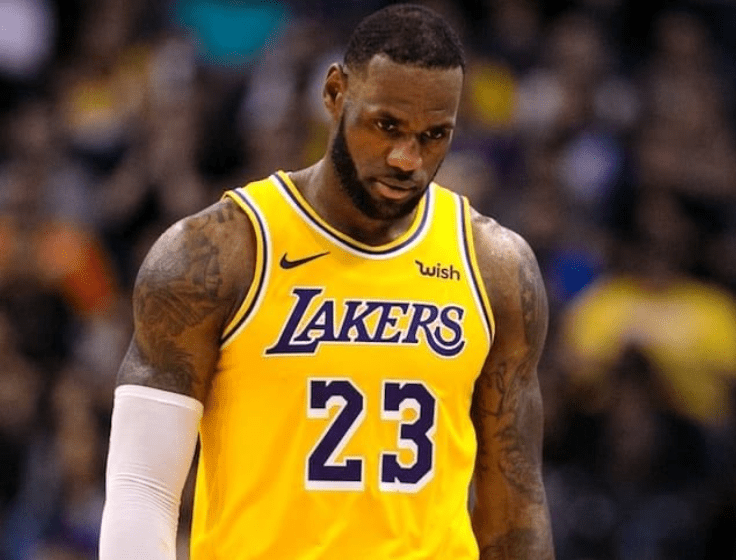
The shift was gradual, almost imperceptible. As years 12, 13, and 14 passed, a strange phenomenon occurred: while his peers declined, LeBron’s body did not break down. He kept climbing the all time ranks, passing legends one by one. He became the youngest player to reach 10,000, 20,000, and 30,000 points. The milestones stacked up: passing Michael Jordan for fourth place in 2019, Kobe Bryant for third in 2020, and Karl Malone for second in 2022. With each passing year and each conquered legend, the impossible math started to look solvable. “It started to become a realistic thing,” James said, “because I felt like my body was not breaking down. That’s when it became a thing”. What began as a career of all around brilliance had, through sheer sustained excellence, accidentally placed him on a collision course with history. The scorer’s crown was becoming an inevitable byproduct of a much grander design.
The Foundation: A Fortress of Durability and Consistency
To understand LeBron’s scoring record, you must first stop talking about scoring. The true foundation is an unprecedented fortress of durability and relentless availability. The numbers are staggering: over 1,570 regular season games played across 23 seasons. He has averaged over 27 points per game for his career, but the more telling statistic is the mind numbing consistency: 19 consecutive seasons averaging at least 25 points per game. He is not a comet that burns brightest for a short period; he is a fixed star in the NBA galaxy.
This duality is key: the record is built on an ironclad will to be great every single night, but never at the expense of winning. It’s availability married to purpose. He has logged over 55,000 regular season minutes, more than any player ever. This monumental workload, managed through a reported million dollar annual investment in his body, provided the thousands of games necessary for the points to accumulate. You cannot score 42,429 points in 800 games. LeBron gave himself over 1,500 chances.
The Evolutionary Genius: Mastering Every Era of Basketball
If durability provided the canvas, LeBron’s chameleon-like ability to evolve his game provided the brushstrokes. His scoring mastery is not of one style, but of every style the NBA has demanded over 20 years. He is the ultimate basketball adaptogen. As a teenage rookie, he was a bulldozer in transition, using nuclear athleticism to attack the rim. By his Miami zenith, he had developed a devastating low-post game and peaked as an efficient three-point shooter, hitting 40.6% from deep in 2012-13. In his second Cleveland stint and Los Angeles tenure, as athleticism slowly gave way to wisdom, he perfected the “old man game”: a lethal, step-back three-pointer and an unstoppable fadeaway jumper that became the shot that broke Kareem’s record.

The NBA’s official tracking data shows this evolution in stark relief. Early in his career, his offense was dominated by drives and shots at the rim. In recent seasons with the Lakers, his game has gracefully shifted toward the perimeter, with jump shots and three-pointers accounting for a much larger share of his offense. This is not decline; this is intelligent adaptation. He has compensated for a step lost in quickness with a leap gained in skill and guile. Furthermore, he has done this while the league itself transformed around him, from a grind it out isolation era to the pace and space three point revolution. LeBron didn’t just survive these shifts; he led them, often serving as a primary playmaker and floor-spacer for his teams. He didn’t master a game; he mastered every iteration of the modern game, ensuring his scoring prowess never became obsolete.
The Ultimate Decoy: How Passing Made Him a Unstoppable Scorer
Here lies the most fascinating secret of LeBron’s scoring title: he achieved it while being arguably the greatest passing forward of all time. With over 11,000 career assists, he ranks fourth on the NBA’s all time list. This is not a separate skill; it is the engine that made his scoring efficient and sustainable. Defenses could never simply load up to stop LeBron James the scorer because they were terrified of LeBron James the playmaker. His legendary court vision and unselfishness forced defenders into a perpetual dilemma.
This duality created his scoring opportunities. Driving lanes opened because helpers hesitated, afraid he’d fire a pass to an open shooter. Closeouts were less aggressive because defenders respected his ability to drive and kick. His scoring averages are not the product of high volume, forced shots, but of high efficiency, intelligent selections within the flow of an offense he often orchestrated. He leveraged the threat of the pass to create better shots for himself. It is the basketball equivalent of a chess grandmaster sacrificing a pawn to win the queen. By making his teammates better and prioritizing team success evidenced by his 10 NBA Finals appearances he created an ecosystem where his own scoring was both potent and preserved.
The Unbreakable Record? The Daunting Math for the Next Challenger
As LeBron continues to add to his total, now over 4,000 points clear of Kareem Abdul-Jabbar, the question arises: is this record ever being broken? The math for any potential challenger is forbidding. A player would need to average a stellar 27 points per game for 20 straight seasons while playing in 79 games a year just to reach LeBron’s current total. That assumes zero decline, zero major injuries, and a career start as early as LeBron’s, who entered the league at 18.
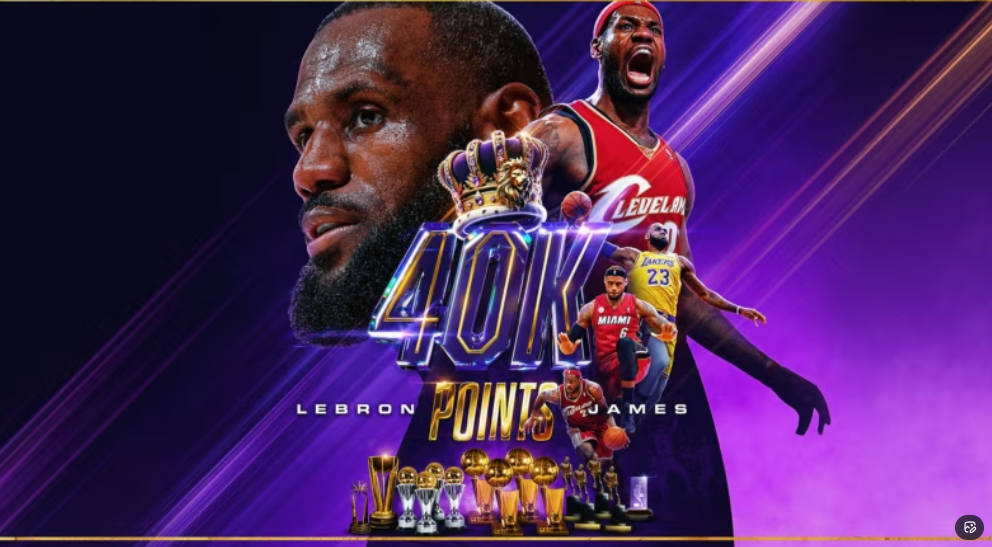
Modern NBA trends work against this. Load management is now commonplace, making 79 game seasons rare. The game’s pace and emphasis on three point shooting can lead to explosive scoring, but also to more volatile, less consistent careers. Most dauntingly, it requires a player who combines the scoring punch of a Kevin Durant, the durability of a Karl Malone, the basketball IQ to evolve like Tim Duncan, and the all-around playmaking ethos of Magic Johnson all while starting at age 18 or 19. It is a recipe with too many perfect ingredients. Even other all-time great scorers recognize the scale. James Harden, himself a top 10 scorer, has admitted “nobody is ever catching what LeBron is doing”. LeBron didn’t just set a new record; he constructed a new paradigm for career achievement that may be unrepeatable. He is the first player to summit this particular mountain because he was the first to possess the unique toolkit to build a road there.
Beyond the Points: The Redefinition of Greatness
In the end, LeBron James’s scoring record is not merely a tally. It is the ultimate data point in a career that has systematically redefined basketball greatness. For generations, the pinnacle was defined by championships and scoring titles claimed at a player’s peak. LeBron introduced a new dimension: sustained, elite dominance across multiple eras, where cumulative achievement became its own form of supremacy. The all time scoring record is the most quantifiable expression of this.
It is a record born not from a selfish desire to score, but from a relentless commitment to being great, available, and intelligent for longer than anyone thought possible. It is the product of a million small choices the cryotherapy sessions, the film study, the unselfish passes, the evolved jump shot. When he hit that fadeaway on February 8, 2023, he wasn’t just making a basket. He was validating a lifetime of process over pursuit. LeBron James became the NBA’s greatest scorer by mastering everything except the selfish obsession with scoring. And in that beautiful contradiction, he authored a record that may truly stand forever.