“The Skill Level Is Off the Chart”: Kevin Johnson on the Quantum Leap of the Modern NBA
“In college… the defender can’t get to it because of distance. In the pros? That same guy is faster, longer, quicker. That pass is getting intercepted for sure.“The skill level of these folks playing now is just off the chart.”
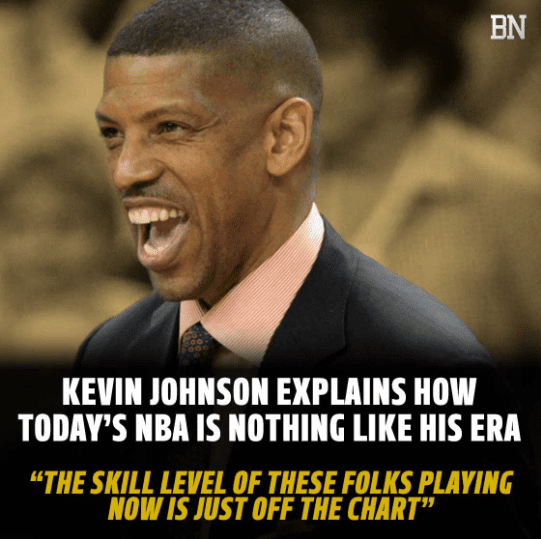
The debate between NBA eras is a perennial pastime for fans, often framed as a clash of physicality versus finesse. Few are better positioned to bridge this divide than Kevin Johnson. A three-time All-Star who averaged 20+ points and 10+ assists for four straight seasons in the late ’80s and early ’90s.

The Golden Era of Point Guards: A Personal Crucible
Johnson entered the league in 1987, squarely in what he calls “the golden era of point guards.” His nightly assignments read like a Hall of Fame roster: Magic Johnson, Isiah Thomas, John Stockton, Gary Payton, Tim Hardaway.

“I never thought I’d play against a point guard that I couldn’t get the best of,” Johnson recalled, highlighting the supreme confidence required to survive. Matchups were mano-a-mano duels where a player’s will was tested as much as his skill.

Despite his success, Johnson’s rookie season was a wake-up call that reshaped his understanding of elite athleticism. On television, players looked impressive. On the court, they were something else entirely.

The Modern Evolution: Positionless Skill at Scale
If Johnson’s era was defined by fierce competition at established positions, he sees the modern game as a revolution in skill democratization and physical prototyping.

1. The End of Positional Constraints: “These days, it’s no longer surprising to see point guards who stand 6’7″ or centers who can shoot three-pointers with ease,” Johnson noted.

2. Universal Skill Sets: The “skill level off the chart” that Johnson marvels at refers to a new baseline. Ball-handling, once a guard’s specialty, is now a universal requirement.

A Legacy of Adaptation, Not Comparison
Kevin Johnson’s perspective offers a nuanced conclusion to the era debate. He isn’t dismissive of the past; he celebrates its unique demands and the legendary competitors it produced. His own career is a testament to excelling in that crucible.

However, his analysis makes a compelling case that the modern NBA isn’t simply a continuation of the past—it’s an exponential leap forward in how the game is played.

The “golden era” he played in was defined by iconic individuals mastering their roles. The current era is defined by a generation of players who have erased those roles entirely.